1940 BRUCE LEE WAS BORN Bruce Lee was born on November 27,
1940, at the Jackson Street Hospital in San Francisco's Chinatown, while
his father was performing with the Cantonese Opera Company in America.
It is an incontestable fact that Bruce Lee was a great martial artist.
His on and off screen persona oozed with charismatic flair making him
one of the most popular action hero's of his time. In death, his popularity
seemed only to grow as legends. Bruce trained hard and had objectives
for himself. In a letter he wrote, he pledged in 1969 to become the
highest paid Asian actor, to become well-known and financially independant
by 1980 and to achieve inner harmony and peace. Bruce had goals and
ambitions that drove him to levels of physical agility, strength and
flexibility that none have been able to compare to as of yet.
Bruce
was affected by Hollywood's and American television's lack of
respect for Asian actors. He felt that if he remained in the U.S.A.,
directors and produces wouldn't look on him as a martial artist
or an actor; they would rather see an Asian and be blinded by
prejudice. Bruce took a sabbatical and went to Hong Kong where
he received a hero's welcome. 'The Green Hornet' known as the
'Kato show' in Hong Kong was very popular because of Lee.
His popularity
got him the attention of prominent movie producers who begged
Bruce to star in their features which he did. From then on the
world was introduced to 'The Big Boss a.k.a Fists of Fury', 'The
Chinese Connection', 'The Way of the Dragon', and 'Game of Death'
which was never completed by Lee
Bruce was affected
by Hollywood's and American television's lack of respect for Asian actors.
He felt that if he remained in the U.S.A., directors and produces wouldn't
look on him as a martial artist or an actor; they would rather see an
Asian and be blinded by prejudice. Bruce took a sabbatical and went
to Hong Kong where he received a hero's welcome. 'The Green Hornet'
known as the 'Kato show' in Hong Kong was very popular because of Lee.
His popularity
got him the attention of prominent movie producers who begged Bruce
to star in their features which he did. From then on the world was introduced
to 'The Big Boss a.k.a Fists of Fury', 'The Chinese Connection', 'The
Way of the Dragon', and 'Game of Death' which was never completed by
Lee.
BRUCE LEE QUOTE
CATEGORY
"When
the opponent expand, I contract, When he contracts, I expand, And
when there is an opportunity, I do not hit--it hits all by itself."
Opportunity
"True
refinement seeks simplicity."
Honesty, Men,
Truth
"To understand
this fully, one must transcend from the duality of 'for' and 'against'
into one organic unity which is without distinctions."
Miscellaneous
"One
great cause of failure is lack of concentration."
Excellence,
Failure
"Not
being tense but ready. Not thinking but not dreaming. Not being
set but flexible. Liberation from the uneasy sense of confinement.
It is being wholly and quietly alive, aware and alert, ready for
whatever may come."
Dreams, Life,
Men, Military, Monarchy, Reading, Sleeping, War
"Knowing
is not enough; we must apply. Willing is not enough; we must do."
Knowledge,
Wisdom
"If you
want to do your duty properly, you should do just a little more
than that."
Desires, Duty,
Wants
"If you
love life, don't waste time, for time is what life is made up of."
Life, Love,
Time
"Ideas
are the beginning of all achievement."
Accomplishment,
Achievement, Beginnings, Goals, Men
"Empty
your mind, be formless, shapeless--like water. Now you put water
into a cup, it becomes the cup, You put water into a bottle, it
becomes the bottle, You put it in a teapot, it becomes the teapot.
Now water can flow or it can crash! Be water my friend."
Friends
"As long
as we separate this 'oneness' into two, we won't achieve realization."
Accomplishment,
Achievement
"A good
teacher protects his pupils from his own influence."
Education,
Evil, School, Teaching
"A goal
is not always meant to be reached, it often serves simply as something
to aim at."
1940
CHIUNE "SEMPO" SUGIHARA - JAPANESE SCHINDLER'S LIST! Chiune
"Sempo" Sugihara, Japanese Vice-Consul to Lithuania in 1940,
is credited with saving the second largest number of Jews from the Holocaust.
(note: Just as Feng
Shan Ho did in Vienna!) Haunted
by the Jewish refugees outside his consulate in Kaunas, Lithuania, Sugihara
was forced to defy his own government's orders, risk his career, and issue
life-saving transit visas, or obey orders and turn his back on humanity.
Sugihara
& his wife worked 16 hours a day for three weeks to save over 40,000
people!
In 1945, Sugihara
was captured by the Soviets. He,
along with his wife and three children, spent the next 16 months in
prison camps in Russia. When he
returned to Japan, Sugihara
was asked to resign from the diplomatic service, "...for the incident
in Lithuania." And forced to take many odd jobs.
In 1984, Yad Vashem recognized Sugihara as "Righteous among the Nations,"
the highest honor which can be bestowed. Chiune Sugihara passed away in
1986, largely unknown, and unrecognized in his native country. It was
not until 1991 that Japan finally apologized to his family. His life was
documented in the film "Visas
& Virtues."
Working
in Alaska
The
cannery work season lasted only 2-3 months. Several thousand men
were dispatched out of union offices in Seattle, Portland, and San
Francisco. Below a group waits on pier 40 to board the ship that
will take them north. April 27, 1939. The arrow points to Tony Rodrigo.
1940
MAXINE HONG KINGSTON IS BORN Writer Maxine
Hong Kingston born in Stockton, CA. Her book, The Woman Warrior, published
in 1976, becomes the most widely taught college-level book by a living author.
1940
TIGER BRIGADE IS FORMED Immediately
after the Pearl Harbor attack, Koreans form the Tiger Brigade under the
California National Guard.
1940
IMMIGRANTS FORCED TO REGISTER Aug.
28, 1940: To comply with the Alien Registration Act, Los Angeles begins
to register its estimated 125,000
foreign-born residents at its processing headquarters in San Pedro.
Immigrants ranged from Mexicans, Japanese, Chinese, Poles, Finns, Germans,
English and Canadians. Many of them had lived in the United States for
years, some as long as 20 years. Against the backdrop of war in Europe,
the new
law required all foreign-born residents over 14 to state their occupation,
political beliefs and personal status. d. It also forbade anyone from
advocating the overthrow of the government. A fine of $1,000 and six months
imprisonment was the penalty for failure to register.
In
United
States v. Masaaki Kuwabara, 27 Nisei (American-born citizens of Japanese
ancestry) were arraigned for failing to appear for a draft physical—the
first step in the conscription process. Like 120,000 other people of Japanese
descent, they had been taken from their U.S. homes after Pearl Harbor
and placed in internment camps. This particular group, however, were among
those classified as especially “disloyal” and incarcerated behind barbed
wire the nearby Tule Lake Segregation Center.
In
a copy of the Selective
Training and Service Act — the 1940 law (and America’s first-ever
peacetime conscription) that required adult men to register with local
draft boards— they found something on which to hang the case: The law’s
prefatory Declaration of Policy stated that “in a free society the obligations
and privileges of military training and service should be shared generally
in accordance with a fair and just system of selective…service.” Arguing
that the case against the Nisei was neither fair nor just and that they
had been deprived of due process, Goodman dismissed the indictment. The
27 men were sent back to Tule Lake. The decision, which was not appealed,
was the only one of its kind issued that was favorable to the Japanese-Americans.
(Judge
Louis E.) Goodman, who was Jewish, took the opportunity to caution the
government against “overzealousness in an attempt to reach, via the criminal
process, those whom we may regard as undesirable citizens.” As Eric L.
Muller and Daniel K. Inouye write in their book, Free to Die for Their
Country: The Story of the Japanese American Draft Resisters in World War
II, “Behind this defense of the Tule Lake ‘undesirables’ can be seen the
passionate views of an immigrant’s son on the role of tolerance in good
American citizenship.” And, it can be said, an inspiration for the passionate
views of another Jewish immigrant’s daughter.
1940
ASIAN AMERICANS AND THE HOTEL INDUSTRY
Indian Americans begin owning hotels and motels throughout the state. 50 years later they own one third of all motels and hotels in the country. In the 1970's and 1980's, Taiwanese Americans follow into the business.
In
his 1937 book "Great
Contemporaries," he (Churchill) described Hitler
as "a highly competent, cool, well-informed functionary with
an agreeable manner . . . . In 1938, he (Churchill) remarked to
the press that if England were ever defeated in war, he hoped "we
should find a Hitler to lead us back to our rightful position among
nations."
In
the event that my motherland (Japan) goes to war in America, just
remember that America is your country. Your father and your uncles
served in the Japanese Army with honor and I do not want you to return
from service in the U.S. Army in discrace." Richard
Sakakida's mother, on the day of his departure for the Philippines
In
San Francisco, the Army opened a small-scale language school in a converted
hangar at Crissy Field on the San Francisco Presidio grounds. It hand-picked
58 Nisei for its first class - sitting on apple boxes and orange crates.
When the top brass saw its value, the school was transferred to Camp Savage,
Minnesota, where it was reorganized as the Military Intelligence Service
Language School.
Classes
began Nov. 1 of this year, with 60 students, 58
of them nisei. About five weeks later, the Japanese attacked Pearl
Harbor, plunging the United States into World War II.
American
Stereotypes of
Asians Before WWII
The hostility toward
Japanese on the West Coast, coupled with the relocation order, prompted
the Army to seek another site for the language school.
The
school moved to Camp Savage, Minn., about 25 miles south of Minneapolis,
where it changed its name to the Military
Intelligence Service Language School. The first language class there
started in June 1942; two years later, the school moved to Ft. Snelling
in the Minneapolis area.
By
war's end, close to 6,000 linguists had graduated from the school. Graduates
were assigned not only to the southwestern Pacific area with Gen. Douglas
MacArthur's forces, Raugh said, but also to the China-Burma-India theater
with Gen. Joseph W. Stillwell's forces, Merrill's Marauders and other
allied units. They interrogated prisoners, translated enemy documents
and intercepted radio transmissions.
In
1946, the language school moved to the Presidio of Monterey, where
it was renamed the Army Language School a year later and added eight or
nine other languages to its curriculum.
Shigeya
Kihara, the last surviving original instructor of the first U.S. Army
language school died on January 16, 2005. Kihara was one of the first four
civilian instructors at the original school. Born in Fairfield, between
San Francisco and Sacramento, Kihara
earned a bachelor's degree in political science from UC Berkeley in 1937
and, after receiving a master's in international relations in 1939, moved
to Japan to study and travel. With the advent of WWII, he came back to the
U.S. during WWII because of his fear that he would be "stuck" in Japan.
Anti-Semitism
was rife among the Allies. Of Franklin Roosevelt, Baker notes that
in 1922, when he was a New York attorney, he "noticed that
Jews made up one-third of the freshman class at Harvard" and
used his influence to establish a Jewish quota there. For years
he obstructed help for European Jewry, and as late as 1939 he discouraged
passage of the Wagner-Rogers bill, an attempt by Congress to save
Jewish children. British Prime Minister Neville Chamberlain said
in 1939 of German treatment of Jews that "no doubt Jews aren't
a lovable people. I don't care about them myself." Once the
war began, Winston Churchill wanted to imprison German Jewish refugees
because they were Germans. What a comfort such leadership must have
been to the Nazis, who, according to the New York Times of Dec.
3, 1931, were trying to figure out a way to rid Germany of Jews
without "arousing foreign opinion."
Click HERE for more info.
A
UC Berkeley professor suggested that he take the job teaching Japanese
to soldiers. Kihara
reported to the 4th Army Intelligence officer at the Presidio of San Francisco.
A week later, Kihara
received an appointment to the U.S. Civil Service as a civilian Army employee
and instructor in Japanese.
In
a 1991 interview with the Herald, Kihara
called the government's decision to start the language school "unprecedented."
"Heretofore, Japanese Americans were considered second-class citizens,
linked to Japan and not to be trusted," he
said. "Here they were asked to do something of vital service to the
United States, very critical not only for the U.S. Army but for Japanese
Americans."
These
legendary
fliers (a ragtag volunteer force) were the model of U.S.-Chinese friendship,
young American pilots who fought for China in World War II that started
in September 1941. The pilots were U.S. military men, many fresh from
training, sent in secret by President Franklin D. Roosevelt before the
United States entered the war. They joined an air force organized for
China by Claire Lee Chennault, a retired U.S. Army colonel.
Churchill
repeatedly praised Mussolini for his "gentle and simple bearing."
In 1927, he told a Roman audience, "If I had been an Italian,
I am sure that I should have been entirely with you from the beginning
to the end of your victorious struggle against the bestial appetites
and passions of Leninism . . . . In the 1930s, U.S. industry was
free to sell the Germans and the Japanese whatever they'd buy, including
weapons. Not to lose out, the British and French sold tanks and
bombers to Hitler . . . . . .
There was no attempt (by the Allies) to contain, isolate, hinder
or overthrow Hitler -- not because of naiveté but because
of commerce. It was the Depression. There were Germans trying to
overthrow Hitler, but the U.S. and Britain and their industries
were obstructing that effort.
Click HERE for more info.
The
Flying Tigers had fewer
than 100 pilots and 55 planes. And it flew for only nine months, until
-- after Pearl Harbor and the American entry into the war -- U.S. forces
arrived in China in May, 1942, and absorbed the unit. The
Flying Tigers fought for the leftists' bitter enemies -- the Nationalists
who ruled China in the 1930s and '40s. "The Flying Tigers supported the
anti-Japanese war," declared Gen. Wang Dinglie, a retired octogenarian
veteran of World War II and the 1949 revolution that ended Nationalist
rule on the mainland.
When the Flying
Tigers arrived, Japanese bombers were pounding undefended Chinese
cities. Japanese forces had captured Shanghai and other coastal cities,
forcing the Nationalist government to take refuge in the remote southwestern
city of Kunming. The U.S. Air Force credits the Tigers with shooting down
286 Japanese planes, while losing just 12 of their own pilots.
Playing
Days
Graduating
in 2008
1941
OSU FOOTBALL PLAYER JACK YOSHIHARA INTERNED Jack Yoshihara,
a Japanese American and a sophomore reserve on Oregon State's football
team, was practicing in mid-December 1941, just as he had throughout the
season. There was anticipation, with the Beavers preparing to play second-
ranked Duke in their first trip to the Rose Bowl game. There was also
fear, with the country still reeling from the attack on Pearl Harbor only
a week or so earlier.
"I will never forget that day," said George Zellick, a teammate of Yoshihara's.
"It was late afternoon. It was drizzling. We noticed two men coming onto
the field. They were very well-dressed, wearing overcoats and hats. You
could tell they were different people. They met with the coach and, the
next thing we new, Jack left with them. It was the first indication that
Jack had a problem."
The
Beavers went to the Rose Bowl, which had been moved to Durham, N.C., because
of the war, and upset Duke. They traveled without Yoshihara, who was not
allowed to go to the game, left school and was soon sent to a civilian
assembly center in Portland. Oregon State and Duke players went to war
after the game. Yoshihara went to the Minidoka internment camp in Idaho.
after Japan bombed Pearl Harbor in December 1941, the United States Executive
Order 9066 in was signed in the spring of 1942 and over 120,000 ethnic
Japanese people were uprooted and were held in internment campus for the
duration of the war.
This
affected the lives of 42 Japanese American Oregon State University students
as they were forced to leave campus, most of whom never returned and were
unable to complete their degree. Those honored were: Noboru Endow, Raymond
Hashitani*, Roy R. Hashitani*, Shigeru Hongo*, Kate Iwasaki*, Masao Kinoshita*,
Kay Kiyokawa, Sigeo Kiyokawa*, Taro Miura, Kay Nakagiri, Tom Namba*, Jack
Nomi, Todd Tadao Okita*, Lena Kageyama Omari*, Tommy Ouchida, Carl Somekawa,
Aiko Sumoge*, Mabel Sadako Takashima*, Masao Tamiyasu*, Edward Ko Yada*,
Mary Takao Yoshida, Jack Yoshihara, and Robert Yoshitomi. (*deceased,
represented by family)
1941
JAPANESE AMERICAN INTERNMENT-RELATED EVENTS August
14:
In a letter to President Roosevelt, Representative John Dingell of Michigan
suggests incarcerating 10,000 Hawaiian Japanese Americans as hostages
to ensure "good behavior" on the part of Japan
STATEMENT
ON TERMINOLOGY
“They were concentration camps. They called it relocation
but they put them in concentration camps, and I was against it.
We were in a period of emergency but it was still the wrong thing
to do.”
Harry S. Truman in Plain Speaking: An Oral Biography of Harry S.
Truman by Merle Miller
The terms used
to describe what happened to over 120,000 Japanese Americans during
World War II vary considerably amongst scholars, government officials,
and even Japanese Americans themselves: relocation, evacuation,
incarceration, internment, concentration camp. No one agrees about
what is most accurate or fair.
NOTE:
. . . that the Japanese, as early as 1934, were complaining
that Roosevelt was deliberately provoking them. In January
1941, Japan protested the U.S. military buildup in Hawaii.
Joseph Grew, our ambassador to Japan, reported rumors that
the Japanese response would be a surprise attack on Pearl
Harbor. Yet according to World War II mythology, America was
blissfully sleeping, unprepared for war, when caught by surprise
by the dastardly "sneak attack." (Isn't it curious
that Asians carry out "sneak attacks," whereas Westerners
launch "preemptive strikes"?) A year earlier, Baker
shows, Roosevelt began planning the bombing of Japan -- which
had invaded China, but with which we were not at war -- from
Chinese air bases with American planes and, when necessary,
American pilots. Pearl Harbor was a purely military target,
but Roosevelt wanted to bomb Japanese cities with incendiary
bombs; he'd been assured that their cities would burn fast,
being made largely of wood and paper.
The
language used to describe the treatment of Japanese Americans during
World War II is often controversial. Some Americans feel that “concentration
camps” is the most appropriate term for the places in which
Japanese Americans were confined. Other Americans associate the
term only with the Holocaust. Although many Americans are more comfortable
with milder terms such as relocation or interment camps, these terms
are historically and legally inaccurate.
Officially,
the camps were named “relocation centers.” Many now acknowledge that “relocation center”
and “evacuation” are euphemisms, used purposefully by
the government to downplay the significance of their actions. Perhaps
the most blatant example is the United States government’s
use of the term “non-alien” to refer to American citizens
of Japanese ancestry as a way of shrouding the violation of constitutional
rights. As historian Roger Daniels has suggested, euphemisms are
part of injustice.
The
government, including President Franklin D. Roosevelt, used the
phrase "concentration camps" in speeches and written documents during
World War II to refer to the places where Japanese Americans were
confined. It is important to note that a concentration camp is defined
broadly as a place where people are imprisoned not because they
are guilty of any crimes, but simply because of who they are. Many
groups have been singled out for such persecution throughout history,
with the term "concentration camp" first used at the turn of the
twentieth century in the Boer War.
Despite
their differences, all concentration camps have one thing in common:
people in power remove a minority group from the general population
and the rest of society allows it to happen.
November 7:Report
prepared by presidential investigator Curtis Munson and submitted to the
President, State Department and Secretary of War certifies that Japanese
Americans possess an extraordinary degree of loyalty to U.S. Corroborates
years of surveillance by FBI and Naval Intelligence, and do not pose a
threat to national security in the event of war with Japan.
November
12: Fifteen Japanese American businessmen
and community leaders in Los Angeles Little Tokyo are picked up in an
FBI raid. Records and membership lists for such organizations as the Japanese
Chamber of Commerce and the Central Japanese Association are seized. The
fifteen would cooperate with authorities, while a spokesman for the Central
Japanese Association states: "We teach the fundamental principles
of America and the high ideals of American democracy. We want to live
here in peace and harmony. Our people are 100% loyal to America."
December
7: Japan bombs U.S. fleet and military base
at Pearl Harbor. Over 3,500 servicemen are wounded or killed. Martial
law is declared in Hawaii.
Mochida
Family
December
7: The FBI begins arresting Japanese immigrants
identified as community leaders: priests, Japanese language teachers, newspaper
publishers, and heads of organizations. Within 48 hours, 1,291 are arrested.
Most of these men would be incarcerated for the duration of the war, separated
from their families.
December
8: U.S. Congress declares war on Japan. Within
hours, FBI arrests 736 Japanese resident aliens as security risks in Hawaii
and mainland.
December
11: The Western Defense Command is established
with Lt. Gen. John L. DeWitt as the commander.
December
1941 - January 1942: The FBI searches thousands
of Japanese American homes on the West Coast for contraband. Short wave
radios, cameras, heirloom swords, and explosives used for clearing stumps
in agriculture are among the items confiscated. Over 2000 Issei in Hawaii
and mainland - teachers, priests, officers of organizations, newspaper
editors and other prominent people in Japanese community are imprisoned
by the U.S. government.
NOTE:
"War Relocation Authority Photographs of Japanese-American Evacuation
and Resettlement" can be found at the Bancroft
Library at UC Berkeley.
1942 ISHIKAWA FISHERMAN / TROUT FISHING AT MANZAMAR For
65 years, a photo taken of Heihachi Ishikawa (aka
“"Ishikawa Fisherman”) by fellow Manzanar
internee Toyo Miyatake was the only photographic evidence that more than
150 of the Manzanar internees "escaped" Manzanar War Relocatin
Camp to go fishing. Ishikawa was a Manzanar legend and a seemingly mythical
person because he would leave the camp for weeks at a time carrying only
a scarce amount of rations in his trek to go after the “Golden Trout.”
It is presumed that he must have had to catch a lot of trout to survive
being away from the camp the weeks he was out. There was no way he could
carried enough provisions to sustain life without living off the land. When
he did returned, he had a stringer of trout.
Cory
Shiozaki's "From Barbed Wire to Barbed Hooks" describes
Ishikawa's incredible story of living off the land in the hard Sierra
mountain range for a couple of weeks at a time - among other stories of
survival. It is another story on how Japanese-Americans used their ingenuity
and called on their bravery to fish Sierra streams and lakes. It symbolized
how they survived as "The fabric of their character was like bamboo.
They bent, but they bounced back and rebounded." These interned Japanese
American fishermen also embraced an expression in Japanese 'shigataganai'
- which loosely translated means, 'it can't be helped.' They embraced
that and found a way to live through it.
Heihachi
Ishikawa was 53 when he was interred at Manzanar in 1942, when Toyo
Miyatake's portrait (who lived in the same block – Block 20, Barrack
12, Apartment 4) at the Manzanar War Relocation Center of him was taken
with his catches and on display at the Eastern California Museum in Independence,
Calif. - along with other images that Miyatake made inside the camp. No
one knows exactly how Ishikawa slipped away to go fishing. He holds the
only evidence of his travels, freedom in a string of trout. Ishikawa found
himself between a rock (Mt. Whitney, highest point in the Lower 48) and
a hard place (Badwater in Death Valley, the lowest). Perhaps a guard dozed
when Ishikawa snaked past the machine guns and rifles in the towers, climbed
the alluvial fans through scrub brush, then followed an ancient Paiute
trail in Shepherd Canyon that eased the nearly vertical pitch of the Sierran
escarpment. The fine brace he displays are the state fish, the riotously
hued golden trout that exist at high elevations. Ishikawa may have fished
the lakes at 11,000 feet, where there is but sky and rock, water and ice,
where every granitic ledge is as sharp as a 1950s Cadillac fin.
The
area he is presumed to have fished is a supremely spare landscape, mind-bending,
almost psychedelic in the scarce air. It has the stark beauty of a Zen
garden, the perfect retreat for a prisoner of his ancestry. He went a
ways to find it: He left the wire behind at 3,900 feet. These are trophy-size
goldens. They're a species known for overpopulating and having stunted
growth. He must be holding lake fish in the portrait, fish that have wintered
over a few years but bear snaky bodies and oversized heads. There isn't
much for a fish to eat where Ishikawa explored.
Heihachi
Ishikawa was a legendary and brave Japanese-American who would risk
his life and sneak out of the well-guarded Manzanar World War II internment
camp north of Lone Pine to go fishing. Ishikawa's mini-journeys from the
mundane life in the relocation camp took him high into the Sierra where
he created his own adventures with handmade fishing gear and caught California's
golden trout. Said Archie Miyatake, 84, who was 16 when he first went
AWOL, or angling without leave: "Once you were out, you feel like
you were in a free area. It was quite a nice feeling just to be out, just
to know you could sneak out."
1942 ALUETS ARE INTERNED Fourteenth
Air Service Group (activated in November 1942
- they eventually had the largest concentration of Chinese American personnel
in the Armed Forces) and the 987th Signal Company mainly consisted of
approximately 1,500
men of Chinese ancestry who enlisted in the U.S. Army whose commanding
officers were White.
Federal
government forced 881 Aleuts to move from their homes on the Pribilof
and Aleutian Islands in the Bering Sea to dank wartime internment
camps in the rain forest of Southeast Alaska 1,500 miles away after
troops from Japan invaded Alaska's western outposts in June 1942. Aleuts
were not suspected of spying or sabotage, as were tens of thousands of
Japanese-Americans interned after Japan attacked Pearl Harbor in December
1941. Officials believed that internment would protect Aleuts from the
fighting in Alaska's distant western islands.
They
were not allowed to leave the camps unless they were drafted into the
military or coerced into working the Pribilof fur seal hunt, which brought
millions of dollars to the U.S. government. Sanitation and pipe systems
were never installed that resulted in a lot of sickness (i.e. pnemonia
& tuberculosis) at the camp. One
in 10 people died in the camps from 1942 to 1945. Families
returned to the Aleutians and Pribilofs in 1944 and 1945 to find their
homes and Russian Orthodox churches looted by U.S. soldiers and rotting
from years of neglect in the wind, rain and salt air.
Aleuts
joined Japanese-Americans in the 1950s through the 1980s in lawsuits seeking
federal restitution for loss of property and civil liberties during internment.
In
1987, Congress approved reparations of $12,000 each to interned individuals
who were still living; $1.4 million for damaged homes and churches; a
$5 million trust for evacuees and descendants and $15 million to the Aleut
Native corporation.
Fourteenth
Air Service Group (activated in November 1942 - they eventually had
the largest concentration of Chinese American personnel in the Armed Forces)
and the 987th Signal Company mainly consisted of approximately 1,500
men of Chinese ancestry who enlisted in the U.S. Army whose commanding
officers were White.
They
were formed at the specific request of then Brigadier
General Claire L. Chennault, Commander of the China Air Task Force
and Lieutenant General Joseph W. Stillwell, Commander of U.S. forces in
the China, Burma, India Theater of Operations, to support aerial operations
in China with Army Air Force support personnel who were fluent in both
the English and Chinese languages. As administrators, mechanics, engineers
and electricians, who could easily communicate with both Chinese soldiers
and civilians, these Chinese American airmen contributed mightily to Allied
success by maintaining aerial operations from airfields across unoccupied
China.
14th
Air Service Group
As a unit of the U.S. Army Signal Corps, the 987th
Signal Company was raised from bilingual Chinese American soldiers
and organized specifically for service in China, with the objectives of
providing communication services and enhancing Liaison between American
and Chinese military organizations.
In
the history of World War II, their
stories have largely been overlooked, overshadowed not just by the
most famous Allied battles and troops but by other segregated groups as
well, such as the all-African-American Tuskegee Airmen fighter pilots,
and the highly decorated Japanese-American soldiers from the 442nd Regimental
Combat Team and the 100th Infantry Battalion, who fought in Europe partly
because they served supporting roles as aircraft-maintenance and communication
specialists, and partly because they served in remote areas of China,
Burma and India.
By
1944, the new
Chinese-American recruits were shipped to about two dozen remote airbases,
mostly in China. Many recovered crashed planes or repaired bullet-ridden
U.S. bombers and fighters.
Due
to a manpower shortage, they
flew Chinese troops and ammunitions over the Himalaya Mountains without
bomber or fighter escort. They
received no military ground support and were armed only with .45- caliber
pistols. Luckily, they escaped any firefights.
When
the United States entered World War II, about 29,000
persons of Chinese ancestry were living in Hawaii and another 78,000
on the mainland. By war's end, over 13,000 were serving in all branches
of the Army Ground Forces and Army Air Forces. About one quarter of all
Chinese-American soldiers served with the Army Air Forces. An estimated
40 percent of Chinese-American soldiers were not native-born citizens.
1942 MING W. CHEN IS BORN Ming Chin
was born August 31, 1942 in Klamath Falls, Oregon. He
received his law degree in 1967 from the University of San Francisco's
Hastings School of Law and passed the bar in 1970 after a two-year stint
as an Army officer, including a year in Vietnam. His
first job as a lawyer was prosecuting felonies and misdemeanors with
the Alameda County D.A.'s office. Chin
is a recognized authority on the use of DNA evidence.
Ming
Chin's 1996 appointment to the seven-seat California Supreme Court
marked an almost inevitable milestone in a pioneering legal career. Chin
had distinguished himself as a capable business litigation trial lawyer
at a time when few Asian Americans had begun entering the legal profession.
That led to his appointment to the Alameda County Superior Court. In November
of 1994 he
was elected to a 12-year-term as Presiding Justice of the First District
Court of Appeals, Division Three, positioning him
to be tapped to the state's highest court by Governor Pete Wilson.
Historical
Side Note
In
1937, when imperial Japanese aircraft "mistakenly" attacked
and sank the U.S. gunboat Panay and several other vessels on China's
Yangtze River, some in the U.S. called for war; but FDR realized
that the U.S. was in fact neither politically nor militarily ready
for such a conflict.
For info, click
HERE
1942
JAPANESE AMERICANS ARE INTERNED!
In the months
following the Japanese
attack on Pearl Harbor, many expected an immediate attack against
the West Coast. Fear gripped the country and a wave of hysterical antipathy
against the Japanese
engulfed the Pacific Coast.
A
Nation Turns on Its Japanese Residents The nation's Japanese population, sensing that it might be targeted
in the wake of the Pearl Harbor attack, quickly went about demonstrating
its loyalty to the United States. Japanese residents bought war bonds,
gave blood, and even ran newspaper ads denouncing Japan. The day after
Pearl Harbor, the Japanese American Citizens League sent a telegram to
President Roosevelt, part of which read: "In this solemn hour we
pledge our fullest cooperation to you, Mr. President, and to our country.
There cannot be any
question. . . . We in our hearts know we are Americans, loyal to America."
Men
were taken away without notice. Most families knew
nothing about why their men had suddenly disappeared, to where they were
taken, or when they would be released. Some arrestees were soon let free,
but most were secretly shipped to internment
camps around the country. Some families learned what had happened
to their men only several years later. The action
also included the freezing of bank accounts, seizure of contraband, drastic
limitation on travel, curfew and other severely restrictive measures.
But this FBI operation merely set the stage for the mass evacuation to
come.
In
January 1942, War Department classifies Japanese American men of draft
age 4-C "enemy aliens." Status not changed until June 16, 1946.
In
February 1942, Lt. Gen. John L. DeWitt, Commanding General of the
Western Defense Command, requested authorization from Secretary of War
Henry L. Stimson to evacuate "Japanese
and other subversive persons" from the West Coast area. On 19 February,
President Franklin Roosevelt signed Executive Order No. 9066 authorizing
the Secretary of War or any military commander to establish "military
areas" and to exclude from them "any or all persons. A month later, President
Roosevelt signed Executive Order No. 9102 establishing the War Relocation
Authority, which eventually operated the internment
camps. Roosevelt named Milton Eisenhower, brother of the future president,
to head the WRA.
:
On that night, the FBI surrounded the Torrance home of Nikuma Tanouye
(Note: One of
his sons, Ted Tanouye, joined the Army and won the Medal of Honor. He
was killed in action.). Documents at the National Archives in Laguna
Niguel tell the story of Nikuma Tanouye and nearly 2,700 other Japanese
citizens and a smaller number of Germans, Italians and others who passed
through Tuna
Canyon Detention Station. Federal archivist Gwen Granados said the
first 35 Japanese nationals arrested (for immigration violations who were
mostly fishermen who worked on Terminal Island) here after Pearl Harbor
were sent to Griffith Park, where there was a makeshift jail with tight
security. They were transferred to Tuna
Canyon, which opened Dec. 15, 1941; it had fences topped by barbed
wire, sentry boxes at each corner and floodlights.
The Tuna
Canyon facility was a former Civilian Conservation Corps camp built
in 1933 on 54 acres near Glendale. It could hold 300 detainees. Authorities
maintained a low profile there, as at the Griffith Park site. Detainees
were subject to Justice Department hearings and trials for such offenses
as curfew violations and failure to register as an enemy alien. Their
detention ranged from a few days to a few months and they were were prohibited
to go within 10 feet of the fence.
American law officers also went to Latin America in 1942, where they rounded
up more than 2,000
Japanese nationals and brought them back to centers such as Tuna Canyon.
Those detainees were held to exchange for American civilians trapped in
Japan. As many as 500 Japanese Peruvians were traded.
Officials were supposed to detain people at Tuna
Canyon temporarily, until they had received a hearing. But "temporarily"
fluctuated: Usually they were held until there were enough inmates to
fill a train, then were moved to inland internment camps. U.S. Border
Patrol Officer Merrill Scott supervised Tuna Canyon. In a May 25, 1942,
report to the State Department, he listed 76
Japanese, 10 German and 16 Italian male inmates.
(The
order did not specify Japanese Americans, but they were the only
group to be imprisoned as a result of it. Eventually 120,000 Japanese,
aliens and citizens, were incarcerated.)
The terms
used to describe what happened to over 120,000 Japanese Americans
during World War II vary considerably amongst scholars, government
officials, and even Japanese Americans themselves: relocation, evacuation,
incarceration, internment, concentration camp.
No one agrees
about what is most accurate or fair.
Japanese
stated "I Am An American"
The language
used to describe the treatment of Japanese Americans during World War
II is often controversial. Some Americans feel that “concentration
camps” is the most appropriate term for the places in which Japanese
Americans were confined. Other Americans associate the term only with
the Holocaust. Although many Americans are more comfortable with milder
terms such as relocation or interment camps, these terms are historically
and legally inaccurate.
Officially,
the camps were named “relocation centers.” Many now acknowledge
that “relocation center” and “evacuation” are
euphemisms, used purposefully by the government to downplay the significance
of their actions. Perhaps the most blatant example is the United States
government’s use of the term “non-alien” to refer to
American citizens of Japanese ancestry as a way of shrouding the violation
of constitutional rights. As historian Roger Daniels has suggested, euphemisms
are part of injustice.
This is a portion of Lt. Gen. J.L.
DeWitt's letter of transmittal to the Chief of Staff, U.S. Army,
June 5, 1943, of his Final Report; Japanese Evacuation from the
West Coast 1942
Intelligence
services records reflected the existence of hundreds of Japanese
organizations in California, Washington, Oregon and Arizona which,
prior to December 7, 1941, were actively engaged in advancing
Japanese war aims.
These
records also disclosed that thousands of American-born Japanese
had gone to Japan to receive their education and indoctrination
there and had become rabidly pro-Japanese and then had returned
to the United States. Emperor-worshipping ceremonies were commonly
held and millions of dollars had flowed into the Japanese imperial
war chest from the contributions freely made by Japanese here.
The
continued presence of a large, unassimilated, tightly knit and
racial group, bound to an enemy nation by strong ties of race,
culture, custom and religion along a frontier vulnerable to attack
constituted a menace which had to be dealt with. Their loyalties
were unknown and time was of the essence.
The
evident aspirations of the enemy emboldened by his recent successes
made it worse than folly to have left any stone unturned in the
building up of our defenses. It is better to have had this protection
and not to have needed it than to have needed it an not to have
had it – as we have learned to our sorrow.
For
more info, click
HERE
The
government, including President Franklin D. Roosevelt, used the phrase
“concentration camps”
in speeches and written documents during World War II to refer to the
places where Japanese Americans were confined. It is important to note
that a concentration camp
is defined broadly as a place where people are imprisoned not because
they are guilty of any crimes, but simply because of who they are. Many
groups have been singled out for such persecution throughout history,
with the term “concentration camp” first used at the turn
of the twentieth century in the Boer War. Joseph
E. Perisco (who wrote the book Roosevelt's Secret War) writes that
President Roosevelt had convincing information from several intelligence
sources that Japanese Americans and Japanese aliens posed no
threat to American security in the event of a war with Japan and yet
disregarded the intelligence reports out of political expedience. Earl
Warren who later became Chief Justice of the U.S. Supreme Court and who
will be remembered as a champion of civil rights: "So
far as this great state of ours is concerned, we have had no fifth-column
activities and no sabotage reported.
Despite
their differences, all concentration camps have one thing in common: people
in power remove a minority group from the general population and the rest
of society allows it to happen.
On
February 27, 1942 - Idaho Governor Chase Clark tells a congressional
committee in Seattle that Japanese would be welcome in Idaho only if they
were in "concentration camps under military guard." Some credit
Clark with the conception of what was to become a true scenario.
On
March 2, 1942 - Public Proclamation #1 issued by Lt. General John
L. DeWitt, head of the Western Defense Command, specifies military zones
1 and 2. Zone 1 includes western halves of California, Washington and
Oregon and southern third of Arizona. A curfew goes into effect in these
areas; all those of Japanese ancestry must remain at home from 8 pm to
6 am.
On
March 18, 1942 - The President signs Executive Order 9102 establishing
the War Relocation Authority with Milton Eisenhower as director.
In
March 1942 - The Wartime Civil Control Administration opens 16 "Assembly
Centers," 13 of them in California, to detain approximately 92,000
men, women, and children until the permanent incarceration camps are completed.
Many of the California residents who eventually end up in Arkansas are
assigned to the Stockton, CA, center which operated from May 10 through
October 17.
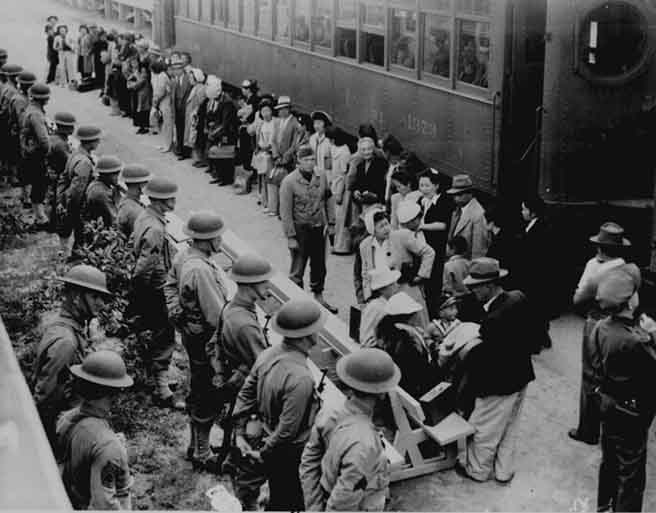
Posters
appeared the length of the West Coast ordering the Japanese to evacuation
points. "Instructions
to all persons of JAPANESE ancestry," read the bold headline on a
typical poster. The text read: "All Japanese persons, both alien and non-alien,
will be evacuated from the above designated areas by 12:00 o'clock noon
Tuesday, April 7, 1942." The evacuees
were told to report for internment with bedrolls and only as much
baggage as could be carried by hand. (A postwar survey showed that 80
percent of the privately stored goods belonging to the interned Japanese
were "rifled, stolen or sold during absence.")
SANTA
ANITA PACEMAKER NEWSPAPER
Soldiers
stand guard as Japanese Americans await their living assignments
at Santa Anita racetrack in April 1942. About 19,000 people
lived in hastily constructed barracks or in converted horse
stalls on the grounds. (National Archives)
Beginning in March 1942, about 19,000 Japanese
Americans from Southern and Northern California lived at Santa Anita
in hastily constructed barracks or in converted horse stalls, which
some evacuees said never fully lost the stench of manure at the
nation's largest assembly center for Japanese Americans on their
way to the internment camps. The Army covered Santa Anita's parking
lot with row after row of identical tar-paper-covered barracks.
The camp was divided into seven districts, and included several
mess halls, a hospital, stores, a post office, classrooms, and makeshift
churches in the track's grandstand. Each evacuee was given an Army
bed, one blanket and one straw tick, the racetrack was surrounded
by barbed wire, searchlights swept the streets at night and residents
were banned from possessing any literature printed in Jap
On
April 18, 1942 - the internees at the nation's largest assembly
for Japanese Americans on their way to the internment camps produced
the first issue of the English-written Santa Anita Pacemaker newspaper.
The first issue had just three question marks asking for a name
for the newspaper. Editor Eddie Shimano stated, "This newspaper
is supposed to set the pace for the Japanese at the center. . .
. A pacemaker in a horse race is the horse that leads the way for
the others to a certain point, and that's what we are going to do."
The newspaper contained official annouincements and community news
- along with some subversive humor when it profiled a Japanese American
family from Arcadia who was interned at Santa Anita, the tongue-in-cheek
headline read, "It Wasn't Much of A Move." The final (50th)
edition was published on October 7, 1942.
War
Relocation Authority / Washington, D.C. / May 1943
The
relocation centers, however, are NOT and ever were intended to be
internment camps or places of confinement. They were established
for two primary purposes:
(1)
To provide communities where evacuees might live and contribute,
through their work, to their own support pending their gradual reabsorption
into private employment and normal American life; and
(2)
to serve as wartime homes for those evacuees who might be unable
or unfit to relocate in ordinary American communities. Under regulations
adopted in September of 1942, the War Relocation Authority is now
working toward a steady depopulation of the enters by urging all
able-bodied residents with good records of behavior to eenter private
employment in agriculture or industry.
For more info, click
HERE
In
May 1942 - The evacuees begin transfer to permanent WRA incarceration
facilities or "camps." They total ten: Manzanar, Poston, Gila
River, Topaz, Granada, Heart Mountain, Minidoka,
Tule Lake, Jerome, and Rohwer.
On
June 3, 1942, the last of 3,677 Japanese-Americans were evacuated
from Oregon,
having been registered as potential threats to national security at the
municipal building at 34 W. Sixth Ave. They were loaded onto the 87th
Civilian Exclusion Order train at Eugene's
railroad station and, after a stop in Medford,
went on to Tule Lake detention camp in Northern California. It would not
be until 1946
that anyone of Japanese ancestry could legally set foot in Western Oregon
again.
On
June 17, 1942 - Milton Eisenhower resigns as WRA director. Dillon
Myer is appointed to replace him.
On
July 1, 1942 - Construction begins on Rohwer Relocation Center by
the Linebarger- Senne Construction Company of Little Rock, Arkansas.
On
July 15, 1942 - Construction begins on Jerome Relocation Center by
A.J. Rife Construction Company of Dallas, Texas.
On
August 4, 1942 - A routine search for contraband at the Santa Anita
"Assembly Center" turns into a "riot." Eager military
personnel had become overzealous and abusive which, along with the failure
of several attempts to reach the camp's internal security chief, triggers
mass unrest, crowd formation, and the harassing of the searchers. Military
police with tanks and machine guns quickly end the incident. The "overzealous"
military personnel are later replaced.
In
September, 1942 - The last of the 16 Assembly Centers close when the
inmates are transferred to concentration camps. The first inmates arrive
at Rohwer, Arkansas. Evacuees came from California and had to endure a
three-day train ride from the assembly centers to reach Arkansas.
FDR
QUOTE:
The argument works both ways. I know
a great many cultivated, highly educated and delightful Japanese.
They have all told me that they would feel the same repugnance
and objection to having thousands of Americans settle in Japan
and intermarry with the Japanese as I would feel in having
large numbers of Japanese come over here and intermarry with
the American population.
For more info, click HERE
According
to the census of 1940, 127,000
persons of Japanese ancestry lived in the United States, the majority
on the West Coast. One-third had been born in Japan, and in some states
could not own land, be naturalized as citizens, or vote.
The Census
Bureau was deeply involved in the roundup and internment of Japanese-Americans
at the onset of U.S. entry into World War II. On Dec. 9, 1941, two
days after the attack on Pearl Harbor, the Census
Bureau produced a report titled ``Japanese Population of the United
States, Its Territories and Possessions.'' The next day the bureau
issued a report on the Japanese population by citizenship and place
of birth in selected cities. The next day it published another report,
this one on the Japanese
population by counties in states on the West Coast. All reports
were based on data from the 1940 census. The Census Bureau stated
"We didn't want to wait for the declaration of war. On Monday morning
(January 1942) we put our people to work on the Japanese thing." **
The United States declared war on Japan that Monday afternoon! (see
below) (Steven A. Lolmes/New York Times/San Jose Mercury News/March
17, 2000) The
Census
Bureau attempts to deny they released information confidential
information such as the names and addresses of Japanese American citizens!
The Census
law ensures that your information is only used for statistical
purposes and that no unauthorized person can see your form or find
out what you tell us - no other government agency, no court of law,
NO ONE.
The Census
Bureau expresses regrets over this situation(!?!?!) in the year
2000!
This
story about Masumi Hayashi first aired March 25, 2004, on
"Outlook." It was rebroadcast Dec. 21, 2006, shortly
after Congress approved $38 million to presevere WW II internment
camps. Our crew enjoyed meeting her, and learning about the
history of the camps. So it was with sadness when we recently
learned she was the victim of a senseless crime. In August,
Hayashi was shot to death in her Cleveland apartment. As a
tribute, we (WV Broadcasting Company) thought it would be
worthwhile to take a second look at the work of Masumi Hayashi
Eight camps
were in the West; the southeast Arkansas
sites at Rohwer and Jerome were the only ones in the South. The Winthrop
Rockefeller Foundation gave $4 million in grants to the University
of Arkansas at Little Rock and the Los Angeles-based Japanese American
National Museum to preserve the information of the Arkansas
internment camp.
At Idaho
Hunt's Minidoka
Relocation Center, 13,000 Japanese-Americans were rounded up from
their homes in Idaho, Oregon and Washington and sent here in World
War II. Unforgettable winter cold, the summer heat or the dust storms
that the wooden barracks covered with tar paper did not keep out made
life even more intolerable.
An interesting
side note is that the California
State Personnel Board voted to bar all "descendants of natives
with whom the United States [is] at war" from all civil service positions."
This was only enforced against Japanese Americans.
All non-citizens
were given the loyalty
questionaire for female citizens, except that it was titled "Application
for Leave Clearance." -- thereby asking them to swear sole allegiance
to the government that excluded them from citizenship.
When
the U.S. government also ordered the detainment
of scores of talented Japanese American baseball players such as Henry
Honda (Cleveland Indians), Herb "Moon" Kurima (Semi-pro league and pitched
a no-hitter/21-strikeout game), Kenichi Zenimura ("Dean of the Diamond"
organized Japanese-American), etc. Baseball leagues were formed in the
camps with people such as Pat Morita playing on the teams. They
paved the way for Ryan
Kurosaki to became the first third-generation Japanese-American
to play in the majors (1975).
These
deplorable
actions occurred, despite comments such as (On
December 15, 1941) After a brief visit to Hawaii, Secretary of
the Navy Frank Knox tells the press, "I think the most effective Fifth
Column work of the entire war was done in Hawaii with the possible
exception of Norway."
For
people interested in further information, please feel free to visit the
following websites:
Citizens
Being Process in Santa Anita
Smithsonian
Museum Tribute to Japanese Americans
Various personal
perspectives and other informative links will be discovered HERE.
Specific
and detailed information on the actual internment camps are listed
HERE.
For a more
specific timeline related directly to the camps can be found HERE.
Read how
the US Government justified the internment (with similar actions used
during the Wen Ho Lee situation),
the evacuation and timeline by visiting HERE.
Tule and
Topaz Internment camp information are located HERE.
View the
documentary, Rabbit
in the Moon about the internment of Japanese Americans during
World War II.
RACISM
DURING WWII Racism
was rampant following the Japanese attack on that infamous Sunday morning.
Wartime hysteria led to the imprisonment of about 120,000 Japanese-Americans
in concentration camps that peppered the western part of the nation. Ted Ohira?s (recipient of three Bronze
Stars) memory of that white face, that voice so saturated with hate that
stated "Hey you dirty Jap." After
all that combat. I went through five major battles in Europe, and I received
lots of awards and medals. ? And then one day, in downtown Los Angeles,
I hear this: `Hey you dirty Jap.' "I
don't cry. I didn't then. I got mad and I wanted to beat that guy up,
but I said `this guy is ignorant.' I had enough of fighting and I just
walked away."
INTERNMENT'S
"EVACUATED PEOPLE" In the interest
of both accuracy and fairness, it is important to distinguish sharply
between the residents of relocation centers and the militarists of Imperial
Japan. Two-thirds of the people in the centers are American citizens,
born in this country and educated, for the most part, in American public
schools. At all centers, the residents have bought thousands of dollars
worth of war bonds and have made significant contributions to the American
Red Cross. Many of them have sons, husbands, and brothers in the United
States Army. Even the aliens among them have nearly all lived in the United
States for two decades or longer. And it is important to remember that
these particular aliens have been denied the privilege of gaining American
citizenship under our laws.
Americans
like to think that victory in 1945 also solved the problem posed
by Japan. Did it? Even today, as the controversial Yasukuni Shrine
reminds us, many Japanese cling to a different understanding of
the Pacific war's origins and justification. As far as China and
South Korea are concerned, victory in 1945 did not solve their Japan
problem; that problem persists and is growing. If East Asia becomes
the locus of renewed great power competition between China and Japan,
V-J Day will no longer look quite so decisive
For more info, click HERE.
It
is also important to distinguish between residents of relocation centers
and civilian internees. Under our laws, aliens of enemy nationality who
are found guilty of acts or intentions against the security of the Nation
are being confined in internment camps which are administered not by the
War Relocation Authority but the Department of Justice. American citizens
suspected of subversive activities are being handled through the ordinary
courts. The residents of the relocation centers, however, have never been
found guilty?either individually or collectively?of any such acts or intentions.
They are merely a group of American residents who happen to have Japanese
ancestors and who happened to be living in a potential combat zone shortly
after the outbreak of war. All evidences available to the War Relocation
Authority indicates that the great majority of them are completely loyal
to the United States.
STUDENT
RELOCATIONS The physical
standards of life in the relocation centers have never been much above
the bare subsistence level. For some few of the evacuees, these standards
perhaps represent a slight improvement over those enjoyed before evacuation.
But for the great majority of the evacuated people, the environment of
the centers?despite all efforts to make them livable?remains subnormal
and probably always will be. In spite of the leave privileges, the movement
of evacuees while they reside at the centers is necessarily somewhat restricted
and a certain feeling of isolation and confinement is almost inevitable.
Life
@ Internment Camp
RELOCATION
CENTERS
The
physical standards of life in the relocation centers have never been much
above the bare subsistence level. For some few of the evacuees, these
standards perhaps represent a slight improvement over those enjoyed before
evacuation. But for the great majority of the evacuated people, the environment
of the centers?despite all efforts to make them livable?remains subnormal
and probably always will be. In spite of the leave privileges, the movement
of evacuees while they reside at the centers is necessarily somewhat restricted
and a certain feeling of isolation and confinement is almost inevitable.
Housing
is provided for the evacuee residents of the centers in tarpaper-covered
barracks of simple frame construction without plumbing or cooking facilities
of any kind. Most of these barracks are partitioned off so that a family
of five or six, for example, will normally occupy a single room 25 by
20 feet. Bachelors and other unattached evacuees live mainly in unpartitioned
barracks which have been established as dormitories. The only furnishings
provided by the Government in the residence barracks are standard Army
cots and blankets and small heating stoves. One bath, laundry, and toilet
building is available for each block of barracks and is shared by upwards
of 250 people.
Food is
furnished by the Government for all evacuee residents. The meals are planned
at an average cost of not more than 45 cents per person per day (the actual
cost, as this is written, has averaged almost 48 cents), are prepared
by evacuee cooks, and are served generally cafeteria style in mess halls
that accommodate between 250 and 300 persons. At all centers, Government-owned
or Government- leased farmlands are being operated by evacuee agricultural
crews to produce a considerable share of the vegetables needed in the
mess halls. At nearly all centers, the farm program also includes the
production of poultry, eggs, and pork; and at a few the evacuees are raising
beef and dairy products. Every evacuee is subject to the same food rationing
restrictions as all other residents of the United States.
Medical
care is available to all evacuee residents of relocation centers without
charge. Hospitals have been built at all the centers and are manned in
large part by doctors, nurses, nurses' aides, and technicians from the
evacuee population. Simple dental and optical services are also provided
and special care is given to infants and nursing mothers. Evacuees requesting
special medical services not available at the centers are required to
pay for the cost of such services. As all centers, in view of the crowded
and abnormal living conditions, special sanitary precautions are necessary
to safeguard the community health and prevent the outbreak of epidemics.
Work opportunities
of many kinds are made available to able-bodied evacuee residents at relocation
centers. The policy of WRA is to make the fullest-possible use of evacuee
skills and manpower in all jobs that are essential to community operations.
Evacuees are employed in the mess halls, on the farms, in the hospitals,
on the internal police force, in construction and road maintenance works,
in clerical and stenographic jobs, and in may other lines of activity.
Most of those who work are paid at the rate of $16 a month for a 44-hour
week. Apprentices and others requiring close supervision receive $12 while
those with professional skills, supervisory responsibilities, or unusually
difficult duties are paid $19. In addition, each evacuee working at a
relocation center receives a small monthly allowance for the purchase
of work clothing for himself and personal clothing for his dependents.
Opportunities for economic gain in the ordinary sense are almost completely
lacking to the residents of the centers.
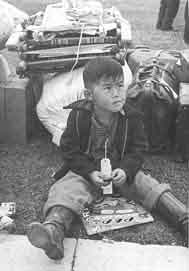
Internment
Camp Kid
INTERNMENT CAMP TEACHERS During their time in the Internment Camps, a group of volunteer
teachers (mostly White) gave Japanese American students hope. In classrooms
that initially lacked desks, textbooks and school supplies, the teachers
somehow ignited the young minds and inspired students to pursue careers
in science, medicine, education. Teachers
such as Margaret Harvey, Katherine Stegner Odum, Joseph Goodman, Margaret
Crosby Gunderson, Lois/Frank Ferguson (who wrote his 1942 thesis at UCLA
boldly criticized prevailing public attitudes that Japanese Americans
were disloyal and unassimilable, and urged understanding of them), Alberta
Kassing, Thomas Temple and Ralph/Mary Smeltzer told students at the Tule
Lake camp not to give up on the Constitution; that the nation's
flawed political leadership was to blame for their unjust internment.
"They
gave to us the link to the America we knew: the sense that not all Americans
were racist, not all of them saw us as a threat but saw the potential
we had as individuals," said Glenn Kumekawa, a retired Rhode Island
professor who was sent to Topaz camp in Utah at age 14 after winning his
San Francisco grammar school's American Citizenship Award.
From 1942 to 1945, an estimated 30,000 children attended the K-12 schools,
which were operated by the federal War Relocation Authority. Teachers
were recruited and hired by U.S. civil service representatives; some signed
up for altruistic reasons, while others just needed a job. The schools
were plagued by inadequate facilities, supply shortages and, in some cases,
frequent staff turnover, according to reports, and most were closed in
late 1945 along with the camps.
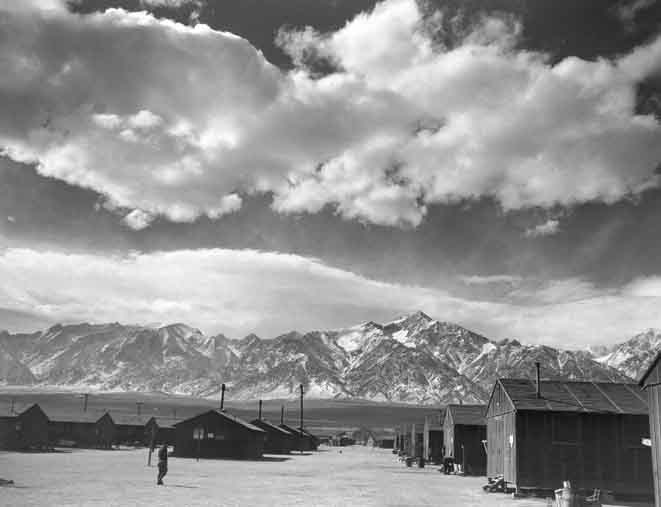
Street
@ Manzanar
INTERNMENT CAMPS
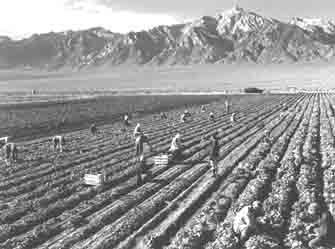
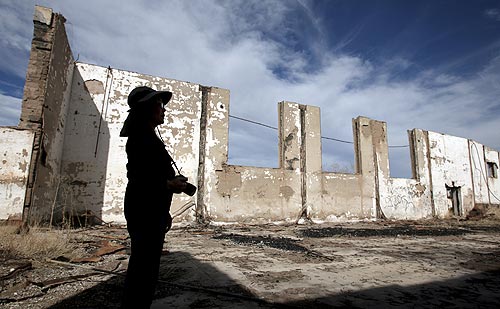
Manzanar was one of 10 internment camps to which the U.S. government sent citizens of Japanese ancestry following the bombing of Pearl Harbor in 1941. It is in the high desert at the base of the Sierra Nevada mountains, northeast of Los Angeles, not far from the community of Lone Pine. Manzanar, officially called the Manzanar War Relocation Center began as an "assembly center" under U.S. army control. In the 1940s, it housed 10,000 internees. The interred were not suspects in any crimes, not guilty of any wrongdoing.
The camp, which consisted of 36 blocks of barracks within a confined area of one-square mile, was the scene of many hardships as men, women, and children sought to establish some semblance of normal life while attempting to overcome the trauma of forced evacuation and facing an uncertain future.
Manzanar
officially closed Nov. 21, 1945. It was designated a National Historic
Site in 1972 after a vigorous, yearlong campaign by Japanese Americans.
The National Park Service maintains the site, which is open to visitors
year-round.
Joyce
Yuki Nakamura (1943)
TULE
LAKE:Surrounded by a 10-foot-high barbed wire "man-proof"
fence and 28 watchtowers, and guarded by a battalion of soldiers and eight
armored tanks, the Tule Lake Segregation Center - 20,000 people, it had
more than 1,600 buildings spread across 7,400 acres - near the Oregon
border was the nation's largest Japanese American internment camp and
in time became the only one of the 10 in the country that was designated
for internees considered security risks. Most of those internees
were known as the "No-No boys," because they had answered "no"
to — or refused to answer — a two-part loyalty question that
asked internees to renounce the Japanese emperor and agree to serve in
the U.S. armed forces. Within a few years of the camp's closing in the
summer of 1946, the once-sprawling settlement was dismantled. Some buildings
fell victim to weather and time. Much of what remained was scavenged:
The jail's metal bars were salvaged for scrap; the internee barracks were
cut in half and given to homesteading veterans; and an officers club was
converted into a grocery store. Even the headstones from the camp's cemetery
were taken as souvenirs and the cemetery was converted into a landfill.
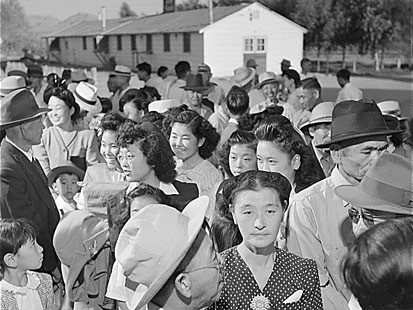
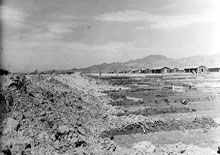
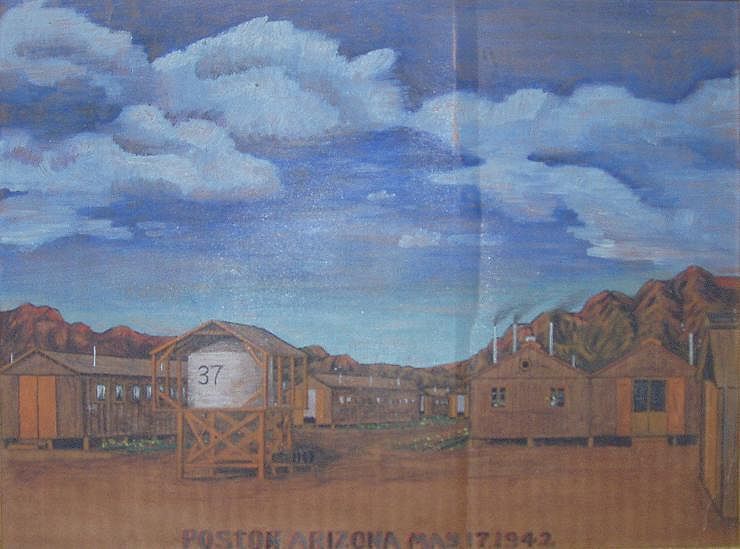
POSTON:Poston was built on the Colorado River Indian Reservation for a specific
reason: Japanese detainees were brought to the desolate location to provide
free, forced labor for the American government. U.S. government sent nearly
20,000 of them to three camps on a Colorado River Indian Tribe reservation
at Poston with an explicit plan to use Japanese Americans -- most of them
Californians skilled in farming -- to help develop tribal lands for later
Indian use. Under the plan, the Japanese Americans helped clear lands
and build irrigation systems, started farms and built schools from handmade
adobe bricks. Their work in developing a reservation that previously had
no electricity, running water or modern homes -- many families lived in
mud huts -- laid the foundation for the tribe to jump-start its standard
of living and thrive financially. The Japanese were ordered to build the
infrastructure — schools, dams, canals and farms — so the
U.S. government could consolidate scattered American Indian tribes from
smaller reservations in one place after the war.
In
this time of racial discrimination and hatred for the Japanese, the plan
was a way to displace one group of unwelcome people and use their hard
work to build the infrastructure so another displaced group of people
— American Indians — could be isolated there after the war.
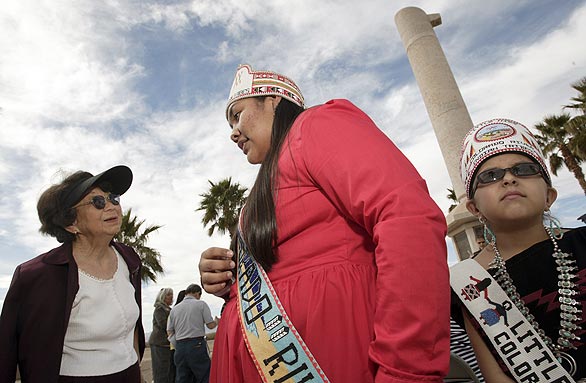
Native
Americans and two dozen former Japanese American internees gathered in
Poston to memorialize their experiences and view a new documentary about
it, "Passing Poston," by New York filmmakers Joe Fox and James
Nubile. They also discussed plans to restore some of the barracks, seek
national historical landmark status for the site and build a museum about
their shared history. This fact was discovered by Berkeley artist and
researcher Ruth Okimoto, 71 years old Tokyo native brought to San Diego
in 1937, who began researching Poston in a personal quest to understand
the experience that had torn her life apart - as noted by the dark and
troubling images began to surface in her work -- a two-faced portrait
of herself, the American flag covering her child's eyes and adult mouth.
The
Japanese American population, peaking at 19,000 scattered over three camps,
dwarfed the 1,200 Mohave and Chemehuevi Indians living on the reservation
at the time. But the encounters were limited, both sides say. An armed
guard was posted at a canal that divided the populated upper reservation
with the lower reservation where the internment camps were placed. And
the Indians were told not to mingle with them.
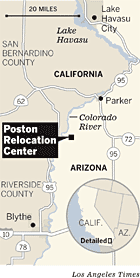
Official
name: Colorado River Relocation Center
Location: Yuma County, Arizona, 17 miles south of Parker
Land: On the Colorado Indian Reservation
Size: 71,000 acres; Poston was the largest of the camps
Climate: Desert; perhaps the hottest of all camps
Origin of camp population:
Mostly from Los Angeles (2,750), Tulare (1,952), San Diego (1,883),
Orange (1,636), Fresno (1,590), Imperial (1,512), Monterey (1,506),
and Santa Cruz (1,222) Counties Via "assembly centers":
Most either came to Poston directly (11,738) or came from Salinas
(3,459) or Santa Anita (1,573) "ASSEMBLY CENTERS"; Poston
also received 469 transfers from Justice Department administered
INTERNMENT CAMPS, the highest figure of any WRA camp
Peak
population: 17,814, the most populous besides Tule Lake
Date of peak: September 2, 1942
Opening date: May 8, 1942
Closing date: Unit I: November 28, 1945 / Unit II: September 29,
1945 / Unit III: September 29, 1945
Project director(s): Wade Head and Duncan Mills Community analysts:
Alexander Leighton, Edward H. Spicer, Elizabeth Colson and David
H.
French; Conrad Arensberg and Laura Thompson were consultants
Percent
who answered question 28 of the loyalty questionnaire positively:
93.7
Number and percentage of eligible male citizens inducted directly
into armed forces: 611 (4.8 %)
Miscellaneous
characteristics:
The most notable incident at Poston was the POSTON STRIKE, described
in detail in the following entry. There was another strike involving
56 adobe workers in August 1942 that was quickly settled.
Poston
was named after Charles Poston, the "Father of Arizona."
What
Okimoto discovered was that the U.S. government had deliberately selected
Japanese Americans with farming experience from California Central Valley
towns like Sacramento, Bakersfield and elsewhere, to help develop the
reservation's agricultural potential, Okimoto said. Researching documents
in the National Archives, along with Colorado River Indian tribal archives
and other sources, Okimoto discovered the then-named Office of Indian
Affairs partnered with the War Relocation Authority to develop an internee
labor plan..
Okimoto
discovered an April 1942 letter from William Zimmerman, the Indian office's
assistant commissioner, to the House of Representatives that outlined
the plan. Zimmerman proposed using the Japanese to transform 10,000 acres
-- clearing it and constructing canals, drainage ditches and flood levees
-- and then cultivate it "as rapidly as possible."
But was the suffering worth
it for America? By the end of the war,
only 10 people had been convicted of spying for Japan.
And
all of them were white.
MIS
Timeline
January
1943
Allied Forces take Buna in New Guinea after brutal island combat.
Phil Ishio saw action.
February
1943
U.S. War Department administers the loyalty questionnaire at all
10 relocation centers. The questionnaire asks Japanese-American
internees about their loyalty to the United States.
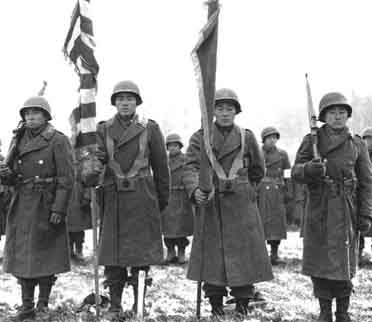
U.S.
Army forms the all-Nisei 442nd Regimental Combat Team. Eventually
the 442nd and the 100th Infantry Battalion unify and become the
most decorated unit for its size in U.S. military history.
March
1943
U.S. forces sink eight Japanese transports and four destroyers headed
for New Guinea during the Battle of the Bismarck Sea.
April
1943
Japanese Admiral Isoroku Yamamoto dies when his plane is shot down
by U.S. forces over Rabau, Solomon Islands. MIS linguists had intercepted
and translated Japanese radio traffic, which revealed the admiral's
plans to travel to Bougainville. Yamamoto was the commander-in-chief
who masterminded Japan's attack on Pearl Harbor.
May
1943
U.S. forces retake the island of Attu, 1,000 miles off the coast
of Alaska, beginning the recapture of the Aleutian Islands. MIS
members, Major White with Nobuo Furuiye and George Hayashida, participate
by making spot translations of captured documents and interrogating
POWs. These actions aid the U.S. forces in formulating an offensive
plan and shortening the campaign.
July
1943
U.S. forces attack the main Japanese base in the Solomon Islands
during the Battle of New Georgia. Captain Eugene Wright, a graduate
of MISLS, leads the MIS team that includes Mamoru Noji. Allied forces
take New Georgia and Solomon Islands.
A
combined American and Canadian force begins assault on Kiska, one
of the Aleutian Islands. MIS linguists become part of the task force
to recapture Kiska.
August
1943
Allied Forces take New Georgia and Vella Lavella islands.
September
1943
Based on the loyalty questionnaire, separation of internees begins.
Those deemed "disloyal" are sent to Tule Lake.
U.S.
Army creates Women's Army Corps (WACs). Japanese-American women
are accepted into the corps. During World War II and in the immediate
postwar period, more than 300 Nisei served in WACs.
September
7, 1943
Joint Intelligence Pacific Ocean Area (JICPOAS), opens. Translation
Section Chief was Lachlan Sinclair. Eventually 800 MIS graduates,
including Don Oka, Nobuo Furuiye, and James Yoshinobu, are assigned
to it.
In
the New Guinea campaign, the following were assigned: Steve Yamamoto,
Buna Pat Neishi, Salamaua Harry Fukuhara, New Britain Kazuhiko Yamada,
Finschafen
November
1943
U.S. Marines attack Bougainville in the Solomon Islands. Throughout
the Battle of Bougainville, MIS linguists' interrogation work elicits
valuable information for the U.S. troops. Shig Yasutake is assigned
to Vella La Vella, Solomon Islands, and William Fisher and Roy Uyehata
are assigned to Bougainville.
U.S.
forces begin assault on Tarawa and Makin in the Gilbert Islands.
MIS linguists help gather intelligence during the attacks.
U.S.
forces begin attack on Tarawa. MIS linguists who help during the
attack are Jack Tanimoto, Frank Hachiya and Edwin Kawahara.
December
1943
Allied Forces begin assault on New Britain. One MIS team lands on
Arawe Peninsula toward the southern tip of New Britain; another
lands on Cape Glouster on the western end.
January
1944
Allied Forces send Merrill's Marauders to participate in the second
Burma campaign. Fourteen MIS linguists are assigned to this special
combat unit, which cleared ground routes in Burma so that Allied
Forces could send supplies to China. With General Vinegar Stillwell
are Captain Chan, Yas Koike, and Grant Hirabayashi, during the second
Burma campaign.
MIS
member Roy Matsumoto is awarded the Legion of Merit for his contributions
during this campaign.
U.S.
War Department announces the reinstatement of the draft for the
Nisei in the detention camps.
At
PACMIRS, Camp Ritchie, Maryland, the following MIS are assigned:
Jim Matsumara, Kazuo Yamane, Seishin Kondo and John Kenjo.
February
1944
U.S. forces take Kwajalein and Majura in the Marshall Islands where
Howard Hiroki and Frank Hachiya participate. American planes destroy
Japanese bases at Rabaul (New Britain) and Truk (Caroline Islands).
Admiralty Islands are also taken by General Douglas MacArthur's
forces.
MIS
members, including Noby Yoshimura, participate in the Battle for
Los Negros in the Admiralty Islands, northwest of Rabaul. S/Sgt
Thomas T. Sakamoto, assigned to the 1,000 men Resconnaissance 1st
Brigade, 1st Cavalry Division, participated in the enemy landing
to capture Los Negros Island from February 29–March 15, 1944.
General Chase awarded Sakamoto the Bronze Star for bravery. Once
the beachhead for Los Negros was secured, Noby Yoshimura and Kenji
Omura followed with elements of the 2nd Brigade. This is where Kenji
Omura loses his life.
MIS
members also participate in the assaults on Gilbert and Marshall
Islands.
The
Joint Headquarters of Generallissmo Chiang Kai Shek and General
Archibald Stuart is located in Chungking, China. MISers present
are Major John Burden and John Morozumi.
March–June
1944
MIS members Yoshikazu Yamada, George Kamashiro, John Anderton, Fabian
Bower and Richard Bagnall translate the Japanese Z-Plan that called
for an all-out counterattack in the central Pacific. The document
is considered the most significant enemy document seized during
the war and leads to the Great Marianas Turkey Shoot in which U.S.
forces shoot down more than 400 Japanese planes during the Battle
of the Philippine Sea. This victory is greatly due to the translation
of the Z-Plan.
April
1944
U.S. forces land at Aitape, New Guinea, eventually taking Hollandia.
For their work in the capture of the Aitape airbase, Masato Iwamoto
and Haruo "Slim" Tanaka are awarded the Legion of Merit
and the Bronze Star, respectively. Gene Uratsu serves in New Guinea.
June
1944
U.S. Navy destroys three Japanese aircraft carriers and 450 aircraft
during the Battle of Saipan in the Marianas Islands.
MIS
members take active part in cave flushing duties. MIS men Ben Honda
and George Matsui receive Silver Stars while Hoichi "Bob"
Kubo receives the Distinguished Service Cross for their work convincing
soldiers and civilians to vacate the caves. MIS member Yukitaka
"Terry" Mizutari is killed in action; he is awarded the
Silver Star posthumously.
By
July 1944, the U.S. Forces took over Saipan, Tinian, and Guam in the
Marinas Islands. George Inagaki, Don Oka, Shiro Sakai, Shigeo Ito,
Tomotsu Koyanagi, Asao Abe, Hiroki Takahasi and James Kai serve here,
and Joseph Kinyone loses his life.
July
1944
U.S. forces take Saipan, Tinian, and Guam in the Mariana Islands.
Twelve
MIS linguists are attached to each of the two regiments of the Mars
Task Force in North Burma. They not only provide language services
but also act as riflemen. Through their efforts, U.S. obtains information
about ammunition dumps and enemy positions and movements.
First
contingent of the Dixie Mission lands in Yenan, China—the
wartime headquarters of Mao Tse Tung and Chou En Lai. Colonel David
Barrett, George Nakamura, Sho Nomura and three other MIS members
serve with the mission to gather military intelligence information.
August
1944
Pacific Military Intelligence Research Section (PACMIRS) is established
at Camp Ritchie, Maryland, to coordinate the efforts of all document
sections in the various war theaters. All field documents from which
information of immediate operational value had been taken are sent
to PACMIRS for detailed scanning.
Increased
enrollment and the need for larger facilities force the MISLS to
move to Fort Snelling, Minnesota. Many new students are draftees
or enlistees from the detention camps or from the "free"
zones outside the camps.
Myitkyina,
Buma, where Herbert Miyasaki and Kenny Yasui serve, falls.
Click
HERE
to continue the timeline
For MIS Background Info, Click HERE
1942
100TH INFANTRY BATTALIAN & 442ND REGIMENTAL COMBAT TROOPS The Japanese
American 100th
Infantry Battalian and the 442nd Regimental Combat troops are united.
After the bombing of
Pearl Harbor, the Government was wary of Japanese-American loyalty and
considered them 4C (Enemy Alien), making them ineligible for the draft.
Dismayed at their exclusion, the discharged veterans of the Hawaiian Territorial
Guard offered services in whatever capacity that the Army might choose to
use them -- cleaning up the grounds, building installations and other menial
tasks. After their diligence and dedication were acknowledged, these Japanese
Americans were recommended to the War Department for a special unit and
sent to the mainland for training in the event of another enemy attack.
The 100th
Infantry Battalion was activated, better known as "The One Puka Puka".
In advanced training, the 100th scored top scores and received a two-week
rest period. In the nine months that the 100th Battalion existed, President
Franklin D. Roosevelt and the War Department were forced, by the steady
stream of petitions and interventions by prominent Americans, to re-open
military service to Americans of Japanese ancestry.
Judoka
in Portland, Oregon, circa 1936.
Front row, seated, left to right: Shigeru Hongo, Victor Davey (?),
Bunuyemon Nii Sensei, Mokuo "Frank" Tomori, Toru Kobayashi.
Back row,
standing, left to right: Unidentified, Art Sasaki, Chiaki "Jack"
Yoshihara, Senta Nii, Unidentified, Unidentified. In
1926 Bunuyemon Nii began teaching Kito-ryu jujutsu at Portland's
Foster Hotel, and in 1927 his student Frank Tomori began teaching
Kito-ryu in Hood River. In August 1932, Jigoro Kano visited Portland,
and as a result Nii and Tomori converted to Kodokan judo; the still-extant
name Obukan ("Oregon Martial Hall") commemorates this
conversion. This photograph was taken during late 1935 or early
1936, and commemorated Nii's retirement (he listed his occupation
as chiropractor) and return to Japan.
Senta
Nii was no relation to Bunuyemon Nii. Jack Yoshihara was the only
Nisei to play on the Oregon State varsity football team the year
it went to the Rose Bowl (1942). Meanwhile, if the identification
is correct, then the individual identified as Victor Davey is the
late father of the well-known martial art teacher Hugh Davey. If
not, then the judoka is instead Mike Arnold.
Conventional wisdom has it that Japanese American athletes
took to judo and other Japanese sports before World War II because they
were too small to participate in varsity athletics. A by-name listing
of Pacific Northwest athletes suggests that the conventional wisdom is
wrong. First, while Nisei athletes were shorter than their European American
counterparts, they weighed nearly the same. Therefore they were at no
significant disadvantage in strength. Second, at least 5% of the available
Nisei male population earned varsity letters in football or high school
wrestling, which is more than "very few." Finally, a by-name
listing shows that Northwest Nisei were more likely to earn varsity letters
than judo black belts, and more likely to become professional boxers than
graded kendoka.
Typical
17-year old Nisei (second generation) athlete of the 1930s packed 132.3
pounds on a 5’5½" frame. T
he
average incoming European American freshman stood 5’8" and
weighed 134.58 pounds. While this was 5 inches and 34 pounds more than
the average Issei (first generation Japanese American), it was only 2-1/2
inches and as many pounds more than the average Nisei. So while the European
American youths may have enjoyed some advantages when playing basketball,
their greater height was probably irrelevant in other sports provided
that the individual players had comparable strength-to-mass ratios.
Noting
only a handful of Northwest Nisei became Golden Gloves or professional
boxers, even fewer became kendo champions. And, while Oregon’s Hal
Hoshino was among the best boxers of Japanese descent anywhere, Washington’s
best kendoka (the Kibei, or Japanese-educated, Kazuo Shoji and Kiyoshi
Yasui) were simply local champions.
1942
FRANK FONG - ONE OF THE FIRST CHINESE AMERICAN FIGHTER PILOTS Frank
Fong
was one of the first Chinese American fighter pilots in WWII. Despite
being told that he would be barred from joining the military, despite
his 1 ½ years of civilian pilot training, his telegram to Air Force Gen.
Henry ''Hap'' Arnold brought the response that ?Americans of Chinese ancestry,
if otherwise qualified, are eligible for aviation cadet [air crew] training''
on January 29, 1942.
Fong's landmark appointment came at a time when the federal government
prohibited the Chinese from entering the United States under the 1882
Chinese Exclusion Act. Not until 1943, with China as an ally, did the
government repeal the act.
After completing training in 1943, Fong shot down two German Focke-Wolf
190 fighters in P-47 Thunderbolt. He provided air cover during the D-Day
invasion of June 6, 1944, in Normandy, France and rescue more than 1,000
pilots between January and May 1945.
In 1972, Fong left the Air Force as a major with more than 400 hours of
combat time and 20 accolades, including eight Air Medals, two Distinguished
Flying Crosses, eight Air Medals and a Purple Heart.
FRANK FONG'S ATTEMPT TO GET VA BENEFITS: It
took 48
years for the U.S. Department of Veterans Affairs to concede
that a plane crash scarred his left eye and eventually took his sight. It
took two more years for the VA to agree that Fong is seriously disabled
by nightmares and flashbacks of violent air combat missions. And nearly
three years to fully compensate
him for his blind eye and for a back injury from the plane crash, VA
records show.
Fong's
battle with the VA isn't over. He's still seeking back pay for the years
1950-1997, when the VA refused to acknowledge his blindness. This 54-year
ordeal illustrates how technicalities in the VA's disability compensation
system shortchange those who lack well-trained advocates and the persistence
to keep fighting for years.
HISTORY:But
during a mission over Germany in the spring of 1944, flying low at 300 mph,
Fong was strafing locomotives when his P-47 Thunderbolt skimmed over a small
hill, crashed through the top of some trees and then hit the ground. His
face slammed into the gun sight as the plane bounced back into the air.
With torn propeller blades and battered wings on his plane, Fong made an
emergency landing.
Shards
from his sunglasses had lodged in his left eye, and his back had suffered
a tremendous jolt. After about 10 days in the hospital, Fong said he told
his doctors he was fine to return to duty - even though his vision wasn't
quite right. The glass shards had gouged his retina, altering his depth
perception and making landings particularly dangerous.
Still,
Fong
flew two missions on D-Day with the 359th Fighter Group, this time in
a P-51 Mustang. On his second mission, flak tore a hole the size of a
basketball in the plane's canopy, slamming pieces into his head and aggravating
his eye condition. From June 5-13, his flight record shows that he flew
10 missions before a flight surgeon ordered him transferred to a regional
hospital for treatment and evaluation.
By
April 12, 1945, Fong's flight rating was downgraded and a flight surgeon
noted: "Severe spinal injury. Healing. Curvature is evident. Eye (retina)
damage." Fong was reassigned to an air-sea rescue unit. Then in November
1945, he was sent to Nautilus Hospital in Miami Beach with recurring problems
with his left eye and spinal injuries, records show. Yet when he left
active duty in May 1946, Fong's official Army discharge exam listed his
eyesight as 20/20 in both eyes. It makes no mention of any crash injuries.
The VA used that against him for decades.
Fong
first asked the VA to compensate him for his blindness in July 1950. The
VA denied his claim, saying that being near-sighted "is not a disability
within the meaning of applicable laws." But the VA awarded him $15 a month
for an ear infection. The VA doctor's report notes that his vision was
far from perfect: 20/70 in the left eye and 20/60 in the right. The exam
appears to be the work of a general practitioner, and there's no indication
that he examined Fong's retina.
Dr.
Harry Hamburger, a Miami ophthalmologist and eye trauma expert, stated
that "He's got a permanent scar there. He's worse than legally blind,"
said Hamburger, a former consulting surgeon at Florida's Homestead Air
Force Base who's examined Fong and his military records. "He just sees
shapes, just gross shapes." In 1951, the Air Force recalled Fong to serve
during the Korean War in the Air Intelligence Group in Washington, D.C.
His official military medical exam in March 1951 reports near perfect
vision in both eyes.
In
contrast, various reports written by a Bolling Air Force Base flight surgeon
show Fong
was cleared only for temporary flight duty: "Officer has history of severe
eye and spinal injuries. Some hearing loss. Vision loss due to air crash
mainly to left eye. Severe spinal injury from impact." But the VA never
pulled Fong's flight records. A week after he was discharged from active
duty in April 1953, Fong reopened his VA disability claim. Again, it was
denied.
Fong
built a life in the Miami area. But the blindness in his left eye was
making work as an artist impossible and he also wasn't coping well with
life, although he didn't know why. In 1997, this time with the expert
help of a service officer from the Florida Department of Veterans' Affairs,
Fong filed another claim with the VA for his blindness, as well as a new
claim for his back injury.
At
a reunion of his World War II fighter group, Fong learned how to get
copies of his flight logs to prove his claims and the VA granted his claims
for blindness and back injury in October 1998 - along post-traumatic stress
disorder, making payments retroactive to the filing of his 1997 claim.
The VA denied his post-traumatic stress disorder claim, based on a VA
doctor's opinion that Fong didn't have the disorder. Finally in June 2000,
the VA finally granted his claim.
In
2002, the VA denied Fong's request that the effective date on his
blindness claim be set back to 1950 - the date he first applied. In 2005,
he is still appealing his case by way of telegram to Five Star General
"Hap" Arnold, head of the Air Force, who personally appointed Colonel
Fong into the military. Colonel Frank Fong broke the barrier for all Chinese
Americans.
Defacing
a Seattle home, 1945.
Photo: Museum of History and Industry
1942
FIRST SEATTLE PROSECUTION AND ACQUITAL Within a day of
Japanese bombs falling on Pearl Harbor, federal agents were at the door
of a Seattle attorney named Kenji Ito. Federal prosecutors charged him
with failing to register as a spy, the first such local prosecution of
World War II, relying on Mr.
Ito's frequent pro-Japanese speeches as evidence of espionage. But
Mr. Ito told jurors he was merely a U.S. citizen trying to educate the
public.
"I'd
rather live in this country behind bars than in another country where
the dictator holds the olive branch in one hand and the dagger in the
other," Mr. Ito told the jury, as his wife watched from the gallery. "If
you convict me, I will know that it's the verdict of Americans."
He
wasn't interned, though. He was arrested for espionage in a case similar
to what happened to many Americans after 9/11. Ito
was one of hundreds rounded up by the FBI in a wave of anti- Japanese
mass hysteria following the attack. No one arrested was ever found guilty
of espionage. Ito himself was acquitted of spying charges by an all-white
jury in 1942.
Despite
the acquittal, his
entire family was subject to U.S. Executive Order 9066, which evacuated
110,000 Americans of Japanese ancestry living on the West Coast and sent
them to internment camps.
Kenji
Ito, who died in 2003 at age 94, was a gifted debater and public speaker.
He became the first Japanese American admitted to the State Bar of California
after World War II and was a pioneering force in the establishment of
Los Angeles' Little Tokyo district.
The
Argus newspaper was a weekly publication edited by H. D. Chadwick.
Months earlier in December, Frank Knox, the Secretary of the Navy,
told the press that he believed a fifth column of saboteurs was
present in Hawaii before Dec. 7th. The fifth column was supposed
to include both Japanese immigrants and American born Japanese,
lending support to Japan in the form of spying, sending reports
of American actions to Japan, or even sabotage. The Argus applied
these ideas to local experience in its story, “The Fifth Column
at Work," which stressed that “japs are employed at Harborview
hospital. Japs are living in, and even operating, hotels on the
western slopes of Seattle’s hills.
The story went on to condemn the government for allowing “American
born Japs” and nationals alike to “remain at large.”
Finally, the story concluded that not all Japanese and Japanese
Americans may be guilty, but it was better to be safe than sorry:
“if the innocent are interned with the guilty, it will not
be a very serious matter. If any japs are allowed to remain at large
in this country, it might spell the greatest disaster in history.”(
Argus, February 14, 1942 p.1)
The
West Seattle Herald was another weekly publication. Almost out of
the blue, on February 26, 1942 along the bottom of the front page
read, “Complete evacuation of aliens -- a common sense move
– why delay?” There was no article on the front page
that would tie this statement into it. On page seven of the same
issue there was an editorial entitled “GET ‘EM OUT!”
On
Bainbridge Island, there were a considerable number of Japanese
American families—most of them connected to various kinds
of farming. We spoke of an American recoil to Japanese treachery
and wrote: and in such recoil of sentiment there is danger of a
blind, wild, hysterical hatred of all persons who can trace ancestry
to Japan…who can say that the big majority of our Japanese
Americans are not loyal…their record bespeaks nothing but
loyalty: their sons are in our army…it [the Review] will not
dispute the federal government if it, in its considered wisdom,
calls for the removal of all Japanese. Such orders... will be based
on necessity and not hatred. (February 5, 1942 p.4)
The
Northwest Enterprise was a weekly publication and the region’s
most prominent African American newspaper. On Friday, December 12,
1941 the Enterprise published an editorial by E. I. Robinson titled
“Let Us Keep Our Record Clear.” In it, the editor spoke
about how there was no need to lose one’s head or commit crimes
in the name of patriotism. He described the Japanese Americans as
good citizens who tend to their own business. But while this piece
was the only one of its kind to appear so close to December 7th
and argued against harming Japanese Americans just because of their
ancestry, the Northwest Enterprise did nothing to oppose internment,
and did not mention the plight of the Japanese Americans again.
The
Japanese American Courier was a weekly newspaper published and written
by Japanese Americans. James Y. Sakamoto was the paper’s founder,
its editor, its publisher, and its main voice. Under a microscope
of suspicion after Pearl Harbor, and already marginalized by racism,
Sakamoto and others at the Courier sought to assure the nation of
Japanese American worthiness of citizenship rights and showed as
many outward signs of their loyalty as they could.
HISTORY
- In 1937, he was a 28-year-old lawyer known for his outspokenness
about the Sino-Japanese War, in which Japan and China fought over Manchuria.Though
the United States supported China, Ito
spoke out for Japan. "I was expressing myself as an American -- of
Japanese ancestry, of course -- who knew something about Japan and Japanese
history," Ito
told The Pacific Citizen, a publication of the Japanese American Citizens
League in 1985.
He
made more than 200 pro-Japan speeches over a three-year period.
"But
that's not spying," said Lee. "People in covert operations don't
just go around giving speeches." The speeches were the main reason
Ito was arrested for plotting to overthrow the U.S. government. The spy
charges were later reduced from espionage to failure to register as an
agent of the Japanese government. The case ultimately ended with Ito's
acquittal.
JAPANESE
AMERICANS IN HAWAII:More than 120,000 Japanese-Americans were
ordered into internment camps during World War II, but despite their large
numbers, few in the territory of Hawaii were forced to leave their homes.
Lt. John A. Burns, a Democrat who went on to be elected governor in 1962,
three years after statehood, was assigned to assist the FBI with interrogations.
Lt. John A. Burns wrote in a Honolulu Star-Bulletin column that Japanese-
Americans in Hawaii were loyal to the United States and it was in America's
interest to cultivate that loyalty. An interracial group started meeting
in Hawaii in 1939 in anticipation of war, fearing the effect on the U.S.
territory would be devastating. Their premise was that how well we get
along during the war will determine how well we get along after. The greatest
sense of urgency came from the Japanese community. But overlooked are
the Caucasian community, business community, Chinese community."
The
group, including Shigeo Yoshida, an educator whose unarchived and uncategorized
files were found at the University of Hawaii,
began working as the Council for Interracial Unity to council combine"pragmatism
and idealism." "The group struck on the idea of involving military
intelligence and the FBI - noting that intelligence agencies had been
keeping watch on the Hawaii populace.
The
group made contact with Robert Shivers, the head of the Honolulu FBI office
who was charged with determining whether the estimated one-third Japanese
population would be loyal to the United States. The group enlisted Shivers
in their cause and surrounded him with advisers that were Nisei second-generation
Americans of Japanese ancestry.
Protest at Topaz Relocation Center. Registration
crisis leads to Tule Lake Relocation Center's designation as a segregation
center. Hawaiian Nisei in the 100th Battalion sent to Africa. Congress
repeals all Chinese exclusion laws, grants right of naturalization and
a small immigration quota
to Chinese.
This
occured after Madame
Chiang Kai-shek gives address at Hollywood Bowl and asks Congress
to repeal Chinese Exclusion laws. After
the repeal of the Exclusion Act and the enactment of the War Bride Act,
acculturation and assimilation began to take place. The once bachelor
society began to shift toward a new American Chinese community filled
with families and children. Finally Chinese
immigrants were legally allowed to become citizens and to own property.
Justice
Harry Low He is the former Insurance Commissioner for the State of California,
Presiding Judge for the California Court of Appeal and judge for
the San Francisco County Superior Court. He was a Past President
of the San Francisco Human Rights Commission, the San Francisco
Police Commission, Chinese American Citizens Alliance and the
Center for Pacific Rim at the University of San Francisco. He
has 25 years of judicial experience in civil, criminal, and government
law while authoring opinions on virtually every area of California
law.
Attorney
Michael Lee
He has been the Past President of the Bar Association of San Francisco,
Legal Aid Society/Employment Law Center, and the Asian American
Bar Association of the Greater Bay Area. He has argued cases before
the United States Supreme Court, U.S. Court of Appeals, Ninth
Circuit, and U.S. District Courts. His principal practice areas
include complex civil litigation, unfair competition, and employment
and labor while serving as a Pro Tem Judge in the San Francisco
Superior Court.
Bill
Ong Hing He is a Professor of Law and Asian American Studies at the
University of California, Davis. Throughout his career, he has
pursued social justice by combining community work, litigation,
and scholarship. He has authored books on immigration policy and
race relations, including Deporting Our Souls—Morality,
Values, and Immigration Policy (Cambridge Univ. Press 2006) and
Defining America through Immigration Policy (Temple Univ. Press
2004). He is on the board of directors of the Asian Law Caucus
and the Migration Policy Institute and serves on the National
Advisory Council of the Asian American Justice Center in Washington,
D.C.
Donald
Ungar He has been practicing immigration law since 1962 and has
litigated numerous cases before the Board of Immigration Appeals,
the federal district courts, and the United States Supreme Court.
He is Professor Emeritus at the University of California at Berkeley,
Boalt School of Law and was the recipient of the first Jack Wasserman
Award for excellence in litigation by the American Immigration
Lawyers Association as well as the Phillip Burton Immigration
and Civil Rights Award.
Connie
Young Yu She has documented the affect of the exclusion laws on the
lives of her grandparents, following a paper trail from Canton
to Angel Island to various Chinatowns. She has written extensively
on Asian America and issues of civil rights and is a board member
of the Chinese Historical Society of America and the Chinese Historical
and Cultural Project. Her books include Chinatown, San Jose, USA
(History San Jose 2001).
1943
COL. YOUNG OAK KIM - 1ST ASIAN AMERICAN OFFICER On January 17, 1943 -
Colonel Young Oak Kim became the first Asian American officer to
exercise command in a combat battalion. Upon graduating as a second
lieutenant from Infantry Officer Candidate School in Fort Benning,
Georgia, Kim chose to join the newly-formed all-nisei 100th Battalion
though, as a Corean American, he could have joined a regular Army
unit.
Kim's most famous exploit was a daylight mission in Anzio.
Having volunteered to capture German soldiers for intelligence, he
and another soldier crawled more than 600 yards directly under German
observation posts without cover. They succeeded in capturing two
prisoners and obtaining information that significantly contributed to
the fall of Rome, for which Kim was awarded the Distinguished Service
Cross. His 100th, along with the 442nd Regimental Combat Team, became
the most decorated unit of its size and length of service in U.S.
military history.
Even after participating in four deadly battles in Italy and
France during World War II and suffering severe injuries that forced
him out of action, Kim felt obliged to resume service as a
battlefield commander when the Korean War broke out. He became the
first Asian American to command a non-segregated U.S. combat
battalion as CO of 1st Battalion, 31st Infantry Regiment, 7th US Army
Division. Kim retired from the U.S. Army in 1972 as a full colonel
after 30 years of active duty and became a respected leader in the
Japanese American community. He remains history's most decorated
Asian American soldier.
1943
KOREAN NEWSPAPER IS FORMED Korean National
Revolutionary Party of Los Angeles begins publishing The Korean Independence.
Its politics result in harassment by Dept. of Justice and deportation proceedings
against staff.
In 1943,
Chinese American women were recruited to serve with the Army Air Force
as "Air WACs." They were often called the Madame Chiang Kai-Shek Air WAC
unit. Hazel Toy Nakashima and Jit Wong were the first two women to become
"Air WACs." They served in such jobs as photo interpretation, air traffic
control and weather forecasting.
Other noteworthy
examples include Chinese American Hazel Ying Lee and Maggie Gee. Hazel
was one of 38 Women Airforce Service Pilots, or WASPs, who died in the
line of duty. Maggie Gee, took male military pilots up for qualifying
flights to renew their instrument ratings and co-piloted B-17 Flying Fortress
bombers through mock dogfights staged to train bomber gunners.
Many Japanese women served in the armed
forces while their families were in internment camps. Many Japanese
and Chinese women were trained as interpreters and translators, and some
Filipino American women put their lives on the line as members of the
underground resistance in the Philippines.
Sixty-one years
ago, Eugene
V. Rostow published the first major academic article on the Japanese
American internment of World War II. The article's title left little
doubt about Rostow's view of the Supreme Court's decisions in Hirabayashi
v. United States (1943) and Korematsu v. United States (1944): The Japanese
American Cases - A Disaster. Rostow's claim was that these two cases
were a substantive disaster of constitutional doctrine - a fundamentally
mistaken endorsement of a repressive military program.
Rostow's
conceptualization of the disaster of the Japanese American cases continues
to define - and, in a sense, to confine - our view of the legal history
of this wartime period. There are, in fact, many more wartime Japanese
American cases to remember than Korematsu and Hirabayashi. These two
cases were really just one small part of a much broader program of litigation
in which the government sought both to capitalize on and to reinforce
the image of Japanese Americans as disloyal subversives.
. . . . Rostow's
assessment of the Japanese American cases as a disaster by recasting
both of those terms. It widens the focus of the term Japanese American
cases to include stories of the many wartime Japanese American cases
that the literature has slighted or forgotten. This broader view reveals
that the Japanese American cases of World War II were a disaster of
a different sort: a litigative debacle, in which an astonishing number
of cases ended in acquittals, dismissals, stern judicial rebukes, and
other repudiations of the government's legal and factual positions.
His article
concludes that the overall litigative project was a misadventure in
using the law - especially the criminal law - to tar a racial group
with the badges of disloyalty during wartime.
"When
you separate out fact from myth, why, their case falls apart,"
Kurtis said. "In this great admiration we have for the greatest
generation, Iva Toguri should be included in those patriots loyal
to America."
Asked
about patriotism in the face of such adversity, Toguri often quoted
her father's admonition: "A tiger doesn't change his stripes."Another
journalist, Ron Yates, became intrigued by the story while serving
as Tokyo bureau chief for the Chicago Tribune. During a golf game,
he asked a friend who had worked for Radio Tokyo about Tokyo Rose.
"He
said, 'She was convicted on really bad testimony.' I said, 'What
do you mean?' " Yates told The Times on Wednesday. His
friend handed him the phone numbers for the two witnesses whose
testimony had led to Toguri's conviction.
"They
said, 'I think it's time for us to come clean,' " Yates said.
"They said they were coached for two months every day before
the trial began. That kind of blew me away."
The
two former Radio Tokyo employees admitted they had perjured themselves
under heavy pressure. Yates wrote a series of articles in 1976 that
made a powerful case for Toguri's innocence.
1944
TOKYO ROSE CONVICTED ON ONE COUNT OF TREASON
Up to the end of World
War II, there had only been some 30 treason cases in United States history.
When Mrs.
Iva Ikuko Toguri D'Aquino went on trial, five Americans had been convicted
of treason for actions in the war, four having broadcast for Nazi Germany,
most notably Millard Gillars, known as Axis Sally. Tom DeWolfe, a special
assistant attorney general, told the jury that Mrs.
D'Aquino had engaged in "nefarious propagandistic broadcasts" without
being under duress. Former supervisors for Radio Tokyo testified that she
had made propaganda broadcasts willingly, and a few broadcast tapes were
played for the jury, though none were identified as containing Mrs. D'Aquino's
voice.
Testifying at the 12-week trial, Mrs.
D'Aquino denied that she had ever made any disloyal statements on
Radio Tokyo. She
was supported in testimony from former Allied prisoners of war who had
worked in the Japanese broadcasting operation. In a statement that she
had given to the F.B.I. in Japan and that was entered in the court record,
she
said that she had sought to reduce the programs' effectiveness as propaganda
by inserting double meanings in some of her broadcasts.
Mrs.
D'Aquino was convicted on a single count of treason, relating to a
broadcast she was alleged to have made to American servicemen in October
1944, referring to the loss of their ships. According to prosecution testimony,
she
said: "Orphans of the Pacific, you really are orphans now. How will
you get home now that all your ships are lost?"
In
one of his last official acts in office, President Ford pardoned Toguri
and restored her citizenship.
Those
who tell her story like to point out that she was born on the Fourth
of July, 1916. Raised by Japanese immigrants in a predominantly white
neighborhood in Compton, she spoke almost no Japanese. She attended
a Methodist church, was a Girl Scout, loved big bands and hated sushi.
For info, click HERE
Several years ago,
Toguri invited Yates to dinner. "She sat across from me and said,
'I always wanted to meet you and thank you. If it wasn't for you I'd still
be a criminal,' " Yates recalled Toguri saying."It was journalists
who got you into trouble," he replied. "And a journalist who
kind of got you out."
On
December 18, 1944, the United States Supreme Court decided the landmark
cases of Korematsu v. United States and Ex parte Endo, the first of which
approved of the forced eviction of more than 120,000 Japanese Americans
from their homes, and the second of which forbade the continued incarceration
of loyal American citizens. Over the months leading up to December 18,
1944, judges and juries in the
lower federal courts across the western United States heard hundreds of
draft resistance prosecutions of young Japanese American internees who
sought to turn their conscription into a legal test of the lawfulness
of their confinement.
BACKGROUND:In 1942, Korematsu was arrested and convicted for being a Japanese
American trying to live in the Bay Area. The day the arrest a newspaper
headline declared, "Jap Spy Arrested in San Leandro."
The
government never charged me with being a spy. I was a U.S. citizen born
and raised in Oakland. He even tried to enlist in the Coast Guard (they
didn't take him because of his race). On
Feb. 19, 1942, anyone of Japanese heritage was ordered excluded from
the West Coast. He
was charged and convicted of being a Japanese American living in an area
in which all people of my ancestry had been ordered to be interned. Hefought his conviction and the case went to the U.S. Supreme Court, but
in 1944 my efforts to seek protection under the Constitution were rejected.
As
his case was being reconsidered
by the courts, Congress created a commission to study the exclusion and
incarceration of Japanese Americans. The commission found that no Japanese
American had been involved in espionage or sabotage and that no military
necessity existed to imprison us. Based on the commission's findings and
of military historians who reconsidered the original records from the
war, Congress passed the Civil Liberties Act of 1988, declaring that the
internment
of Japanese Americans was unjustified. Finally, it seemed that the
burden of being accused of being an "enemy race" had been lifted
from our shoulders. As the result of his convictions, Fred
Korematsu was awarded the nation's highest civilian honor, the Presidential
Medial of Freedom, in 1998.
President Clinton has stated the following words: "In the long history of our country's constant search for justice,
some names of ordinary citizens stand for millions of souls --
Plessy, Brown, Parks . . . To that distinguished list today we add the name of Fred Korematsu . . . helping to
widen the circle of democracy by fighting for human rights, by righting social wrongs, and by empowering others to achieve."
PASSING OF FRED KOREMATSU:Civil rights activist Fred Korematsu, who
unsuccessfully fought the order to be sent to a Japanese American internment camp during World War II, died Wednesday: March 30, 2005 at the age of 86. Korematsu died of respiratory illness at his daughter's home in Larkspur, said his attorney Dale Minami. Korematsu is survived by his wife, Katherine, his daughter, Karen,
and son, Ken. Minami stated the following: "He had a quiet courage, that's the best way to describe him. He did things because he thought the were right. He
just thought this was wrong . . . Fred was a giant in our community and a man who fought not only for the civil rights for Japanese-Americans but for all Americans . . . He took an unpopular stand at a time when the country was in crisis. And he withstood criticism and ostracism 40 years later."
In recent years, Korematsu remained active in civil rights issues, speaking out against parts of the Patriot Act that he felt violated the rights of Arab Americans.
"He felt like what was happening to Arab Americans was very similar
to what happened to Japanese Americans," Minami said. "Part of his legacy is that he challenged the government in a time of war. ... He
continued speaking out in support of civil rights and the Constitution for years and years."
Japanese
American Soldiers
1944
PEOPLE CAN'T BE DRAFTED IF THEY'RE "INTERNED" Trial
of the Heart Mountain Fair Play Committee for conspiracy to violate
selective service law in the largest mass trial in U.S history (Cheyenne,
WYO). FPC
(Fair Play Committee) refused to be drafted while they and their families
were interned in the camps.
These
85 interned Japanese
Americans were prosecuted and incarcerated because they
refused to be drafted into the U.S. military unless their rights as citizens
were restored.
Frank
Abe's (former KIRO-TV news reporter) film ("Conscience
and the Constitution") documented this fact that has sharply divided
Japanese America for more than 50 years. The film (Conscience
and the Constitution) provided evidence that was contrary to popular
opinion that his parents' generation surrendered their constitutional
rights without question after the outbreak of World War II.
The Japanese American
Citizens League, a group devoted to Americanism, believed that loyalty
had to be proven by providing the "right" for Japanese Americans to volunteer
and/or be drafted for combat duty. As
a result, the resistance
was opposed by the Japanese American Citizens League who worked with the
U.S. government to create the segregated volunteer 442nd Regimental Combat
Team of Japanese-Americans who served in Europe. The JACL condemned the
resisters in its newspaper, the Pacific Citizen, and many believed it
worked to identify leaders of the Fair
Play Committee. Even the American Civil Liberties Union refused to
help the resisters.
In 1942, Fred
Korematsu was ordered to be unjustly incarcerated with 120,000 other
Japanese Americans. Mr. Korematsu refused to be interned, and was convicted
of failing to report to an internment camp in 1944. He appealed his conviction
all the way to the Supreme Court but lost. Forty years later, in 1988,
with the representation of Asian Law Caucus of San Francisco, Fred
Korematsu re-opened his case and had the conviction overturned. Fred
Korematsu has become a hero for the civil rights movement for Asian Americans,
and in 1998, President Clinton presented him with the Medal of Freedom,
the highest civilian award of the United States.
Frank
Emi and Kiyoshi
Okamoto (the Fair Play Committee of One) started the protest
movement at the Heart Mountain camp in Wyoming. At
Heart Mountain,
63 young men who refused to board the inductee buses were taken into custody.
They were tried, convicted and sent to prison
for draft evasion, eventually serving more than two years. Twenty-two
more convictions followed. Eventually the leaders of the Fair Play committee
were also arrested and imprisoned. These
resisters,
who fought their battle in the courts, were scorned as draft-dodgers and
traitors, while their families
were ostracized.
In 1988, the U.S. government finally admitted that the internment
camps were wrong. It took another 12 years (2000) before the JACL
made a formal
apology for turning their backs on the Heart Mountain resisters.
The
Seattle Star had mobilized public opinion against Japanese Americans
since the 1920s and editorialized against resettlement soon after
the federal announcement (12-14-44).
1944
CHINESE AMERICAN SOLDIERS IN WWII! Chinese
Americans, like all other Americans, bravely served to preserve the
American way of life and to advance democratic ideals around the world
during WWII. Of the six million Americans who were drafted or enlisted
to serve in the Second World War, over 20,000
Chinese Americans served in the Army,
Navy, Air
Force, the Marines, and the Coast Guard. These brave
men and women served
with honor in the European, Pacific, and the China-Burma-India Theatres
of Operation. While most of these men
and women are descendants of earlier Chinese immigrants, some were also
first generation immigrants. It has been
documented that these servicemen
and women brought valuable skills and served the United States in a number
of different capacities, as fighter pilots, intelligence
operatives (Europe & Asia), infantrymen, nurses, and others
throughout WWII. These great Asian Pacific American soldiers
were honored by Congress on October
26, 1999.
OSS organized eight rescue missions, all under code names of birds: Magpie
(heading to Peiping), Duck (Weihsien), Flamingo (Harbin), Cardinal (Mukden),
Sparrow (Shanghai), Quail (Hanoi), Pigeon (Hainan Island), and Raven (Vientiane,
Laos). The teams took off from Si'an (today called xi'an).
The team that parachuted into Bejing liberated 624 Allied prisoners including
survivors of the Doolittle raids on Tokyo. One team rescued American General
Jonathan Wainwright, hero of Bataan, and 1,600 other Allied POWs in Mukden.
The OSS mercy mission that flew to Taiwan parachuted into Hainan Island
with the team that evacuated 400 starving prisoners there. On August 17,
1945, Tad Nagaki parachuted from a B-24, named "The Armored Angel," with
five other American heroes to rescue me and 1,400 other prisoners from
the Weihsien Concentration Camp in China's Shangtung Province.
Tad Nagaki and members of these rescue teams were honored with the Soldier's
Medal for heroism.
MIS
Timeline
September
1944
U.S. forces take Palau Islands.
October
1944
U.S. forces land on Leyte for the Battle of Leyte Gulf. In the
largest naval
battle of the Pacific War under the command of Admiral Raymond
Spruance, U.S. forces destroy most of the remaining Japanese naval
forces. Due to MIS translation of the Z-Plan, the Japanese Navy's
defensive plan for the Philippines was already well known to the
Allied Forces. Hundreds of MIS linguists, including Hakumasa Hamamoto,
Walter Tanaka, Fred Nishitsuji, serve in the Leyte campaign. Warren
Higa and Ralph Saito serve in Dulag.
Under
General Ike Eisenhower, Major John White, Kazuo Yamane, George
Urabe and Pat Nagano serve at Supreme Headquarters Allied Expeditionary
Forces in Paris, France, to intercept communication between Japan
and the Japanese Embassy in Berlin.
The
442nd Regimental Combat Team (including the 100th Infantry Battalion)
rescues the 36th Infantry Division ("Lost Battalion")
after five days of continuous battle. The 442nd/100th unit suffers
more than 800 casualties to rescue the 211 Texans
.November
1944
Forty-seven Nisei, three Caucasians, and one Chinese American
of the Women's Army Corps (WACs) report to Fort Snelling for Japanese
language training. They are trained in written Japanese to qualify
as translators.
December
1944
Victor Abe serves in Mindaneo and William Dozier and Stanley Shimabukuro
serve in Leyte. U.S. forces retake Leyte. MIS linguist Frank Tadakazu
Hachiya is killed in action; he is awarded the Silver Star posthumously.
January
1945
U.S. forces invade Lingayen Gulf, Luzon, in the Philippines with
Susumu Toyoda and Yukio Kawamoto participating. Working together
with Filipino guerilla soldiers, several MIS teams participate
in the battle of northern Luzon to provide key strategic intelligence.
At
S-2, Japanese Military Intelligence Division, Canadian Army, Vancouver,
Canada requests services of MISers Dye Ogata and Ted Kihara as
instructors in Japanese. In Hood River, Oregon, the American Legion
removes the names of 17 Nisei soldiers from the community honor
roll.
Exclusion
orders on Japanese and Japanese Americans from the West Coast
are revoked.
February
1945
U.S. forces retake Bataan, Philippines. The MIS team attached
to the XIV Corps enters Manila.
March
1945
U.S. forces retake Manila and Corregidor in the Philippines where
MIS linguist Harry Akune parachutes into battle. Other MISers
were Norman Kikuta, Milton Tanizawa and Tom Kadomoto. Shizuo Tanakatsubo
participates in Mindoro and Moffet Ishikawa serves in Panay, Philippines.
American
planes firebomb Tokyo.
U.S.
Marines take the island during the Battle of Iwo Jima. More than
50 MIS men serve with the 3rd, 4th, and 5th Marine Divisions.
They convince many Japanese soldiers to surrender. The MIS men
include Manny Goldberg, Terry Doi, and Tadashi Ogawa who convince
many Japanese to surrender.
April
1945
In the final amphibious landing, U.S. forces attack more than
130,000 Japanese soldiers in the Battle of Okinawa. MIS translations
contribute to the shortening of the Okinawan campaign. In one
instance, translation of the Japanese defense plan for Okinawa,
including a signal codebook, gives U.S. forces information about
defense strategies and troop positions. MIS linguists also translate
a chart showing the artillery locations and heavy mortar positions
of the Japanese defense line that had withstood repeated American
assaults. Many MIS soldiers had relatives in Okinawa.
Vic
Nishijima, James Shigeta, Hiroshi Mukae, Tom Matsui, Ben Hazard,
Wally Amioka, Warren and Takehiro Higa, Warren Sukuma, Leg Nishiyama,
Ralph Saito, and Dan Nakatsu participate. Mitsuo Shibata, Eddie
Fukui, and Ben Kurokawa are killed in action.
June
1945
U.S. forces retake Okinawa.
August
1945
U.S. B-29s drop atomic bombs on Hiroshima (August 6) and Nagasaki
(August 9). The Soviet Union enters the war against Japan and
invades Manchuria (China). Paul Otaki, Ardaven Kozono, and Yoshito
Iwamoto serve in the Philippines. Shoichi Nakamura is KIA. General
Tomoyuki Yamashita surrenders in North Luzon where MIS soldier
Koyoshi Fujimori served.
August–September
1945
Japan formally surrenders (September 2). Representatives of the
Japanese government sign the formal instrument of surrender aboard
the USS Missouri. Three MIS officers, Tom Sakamoto, Noby Yoshimura,
and Kiyoshi Hirano are on board to observe.
Singapore
surrenders to Lord Louis Mountbatten with MISer Tim Hirata present.
August
1945
More than 5,000 MIS Nisei participate in major assignments covering
military government, disarmament, intelligence, civil affairs,
land reform, education, and finance during the Allied Occupation
of Japan (1945–1952). They also help develop the Japanese
Constitution.
Click
HERE
to continue the timeline
For MIS Background Info, Click HERE
HOW
THE TEAMS WERE FORMED In
July 1943, the Office of Strategic Services (OSS) asked for Nisei
volunteers for "highly secret" intelligence work. "More hazardous than
combat," some of them were told, "a one-way ticket." 13 Nisei qualified
to be part of an elite team of Nisei in 0SS Detachment 101. Every one
of them knew when he volunteered that it was much more dangerous for
him as a Japanese-American than for others.
The OSS trained the Nisei team first in radio school in Naperville, Illinois,
then the Military Intelligence Service Language School in Fort Savage,
Minnesota, then six weeks of survival and demolition at Toyon Bay on Catalina
Island.
Dropping into Northern Burma in January 1943, OSS Detachment 101 was the
first espionage unit the United States used behind Japanese lines. Deployed
in China, Burma and India, it had 250 officers and 750 enlisted men trained
in parachuting, radio operations, infiltration, survival training, hand-to-hand
combat, cryptography and guerrilla tactics. An American-led intelligence
outfit with unconventional methods, it was led by Carl Elfier and William
"Ray" Peers.
In 1943, when the Japanese announced that captured flyers would be given
"one way tickets to hell," Detachment 101 and their Kachin Raiders began
rescuing downed crews. Morale of Allied airmen in the Tenth Air Force
- many of them flying over "The Hump" - improved. Detachment 101 rescued
some 400 Allied flyers.
AWARDS: Soldier's Medal: Sgt Tadash Nagaki, intepreter, and T/4 Raymod
N. Hanchulak, medic, are awarded the Soldier's Medal for heroism in 'Shanghia,
1945, for their part in liberating 1,400 Allied prisoners from the Weihsien
Civilian Assembly Center in China's Shantung province, August 1945.
The Nisei plunged into the work of sabotage, guerrilla warfare, hit-and-run
harassment operations, translating Japanese documents, preparing propaganda
leaflets, interrogating prisoners and building airfields. Calvin Tottori,
a member of the Nisei team, documents their exploits in a fascinating
collection of unpublished memories, The O.S.S. Niseis in the China-Burma-India
Theater.
RISKS: Being mistaken for the enemy was always a possibility. Nisei Lt.
Ralph Yempuku was assigned to the 1st Battalion Kachin Rangers under Captain
Joe Lazarsky. The Kachins hated the Japanese. Japanese had tied villagers
to trees and bayoneted them to death. "The Kachins were initially very
wary about me because I was a Japanese-American," Yempuku recalls. "On
the first day, Captain Lazarsky paraded me in front of the whole battalion
introducing me as an 'American' and ordering them to study my face so
that I would not be mistaken for and shot as an enemy Japanese."
As the war wound down in Burma in the summer of 1945, Detachment 101 Niseis,
battle-hardened in India and Burma, were deployed to China, to report
to OSS Detachment 202 headquarters in Kunming to accomplish their rescues.
1945
2 FILIPINO AMERICAN WOMEN AWARDED US MEDAL OF FREEDOM!
Guerrero and Finch were awarded the U.S. Medal of Freedom after the war
for their exploits with the Philippine underground resistance movement
that are listed below.
Josefina
V. Guerrero supplied American POWs with food, clothing and medicine
and passed them contraband messages,
Judy Bellafaire (curator of the Women in Military Service for America
Memorial) said. "In the early days of the Japanese occupation, she
was asked to map Japanese fortifications at the Manila waterfront. Her
map included information on secret tunnels, air raid shelters and a number
of new installations in which the allies were interested."
Shortly before the American invasion of Manila in 1945, Guerrero carried
a map through Japanese-held
territory that showed the location of land mines along the planned invasion
route, Bellafaire said.
"She
walked most of the way with the map taped between her shoulder blades,"
Bellafaire said. "She strapped a pack on her back, distracting the enemy,
who concentrated their searches on the pack rather than on her. She reached
the 37th Infantry Division with the map, enabling the Americans to avoid
the land mines that had been laid for them."
Florence
Ebesole Smith Finch, the daughter of an American soldier and a Filipino
mother, claimed Philippine citizenship to avoid being imprisoned by the
Japanese, Bellafaire said. "She joined the underground resistance movement
and smuggled food, medicine and other supplies to American captives."
Finch was eventually arrested by the Japanese, tortured and sentenced
to three years' imprisonment, Bellafaire said. American forces liberated
her after she'd served five months of her sentence. She went to Buffalo,
N.Y., her father's hometown, and enlisted in the Coast Guard, the curator
said, to "avenge the death of her late husband," a Navy PT boat crewman
killed at Corregidor, the Philippines.
This in addition to all the Filipino Americans that had served in the
Army and Navy.
Remembering
that Roosevelt never told MacArthur to concede defeat in the Philippines,
MacArthur was hopeful that upon his arrival in Australia would allow him
to take over a U.S. invasion force. But to his dismay, the “5 mile
convoy” promised was not there and he had to wait before he could
finally make good on his “I shall return” pledge. Filipinos
gained the respect of America, Europe and the world after they had witnessed
the courage and tenacity of Filipino soldiers against overwhelming foes.
Winston
Churchill, disappointed at the very early capitulation of British forces
in Malaya and Singapore, praised the Philippine Scouts as “soldiers
with no equals in the world.” U.S. Army annals singled out the Philippine
Scouts, particularly the 26th Cavalry, the last U.S. army unit to actually
fight on horse back as the best fighting unit in Bataan, even better than
their counterparts in the regular U.S. Army who fought with them there.
The Philippine Commonwealth Army which included the PC and hastily recruited
ROTC cadets untested as combat soldiers proved their worth and gained
the respect of the world. Many of them later fought on as guerrillas,
until the Philippine Islands was liberated in 1945. (Col Romy Monteyro, PA, AFP -Ret. - Columnist, Philippine Mabuhay News)
In
1947 the United States concluded an agreement with the Republic of the
Philippines concerning military bases which specified that the United
States would be permitted to recruit citizens of the Philippines for voluntary
enlistment into the U S Armed Forces. However, there was no requirement
for such recruitment prior to the Korean Conflict. Expanded personnel
requirement at this time resulted in an urgent need for additional stewards
in the U. S. Navy. Consequently an agreement was negotiated in 1952 based
upon the 1947 treaty whereby up to 1,000 Filipino citizen could be enlisted
in the US Navy each year. This agreement was amended upon the request
of the United States in 1954 to raise this number to 2,000 a year. The
agreement between the two Governments maybe terminated by either party
on 1-year notice.
1946
LUCE-CELLER BILL Luce - Celler
bill grants right of naturalization and small immigration quotas to Asian
Indians and Filipinos. This bill
amended the Immigration Act of 1917 ("Barred Zone"), allows 100 immigrants
from India and the Philippines to enter the country and makes persons
of Indian and Filipino descent living the United States eligible for citizenship.
Governor
Mon Wallgren, Mayor William Devin, and Congressmen Henry "Scoop"
Jackson and Warren Magnusen were among the public officials who
initially spoke out against allowing Seattle's Japanese American
residents to return to the area. (Seattle PI 1-23-45; Times 12-18-44
1946
JAPANESE AMERICAN CONCENTRATION CAMPS ARE CLOSED
All
the concentration/internment
camps are closed. The Philippines have become independent from the
United States. United States citizenship are offered to all Filipinos,
not to just servicemen.
1946
FILIPINOS AND INDIANS CAN BECOME CITIZENS Filipino
Naturalization Act
extends US citizenship to residents arrived before March 24, 1943. Luce-Cellar
Bill signed, allows Asian Indians to become US citizens and sets a yearly
quota of 100 immigrants.
1947
WATARU MISAKA Wataru Misaka (who grew up in Ogden, Utah) was the first Japanese-American to play professional basketball at the highest level in the United States. Misaka's brief career in New York was short since the Knicks cut Misaka, a 5-foot-7 point guard, after three regular-season games in 1947. He was a pioneer in the Basketball Association of America, which became the National Basketball Association in 1949 (a year before the league admitted its first black player). He turned down an informal invitation to play for the Harlem Globetrotters.
The Knicks drafted Misaka shortly after a memorable defensive performance in the championship game of the 1947 National Invitation Tournament. He held Ralph Beard of Kentucky to 1 point, and his six-man Utah team upset Kentucky, coached by Adolph Rupp, 49-45, in Madison Square Garden. An article in The New York Times on March 25, 1947, described his impact: "Little Wat Misaka, American born of Japanese descent, was a 'cute' fellow intercepting passes and making the night miserable for Kentucky."
In college, Misaka helped Utah win two championships with his defensive skills. The first came in 1944. Although the Utes lost to Kentucky in the first round of the more prestigious N.I.T., they were invited at the last minute to the eight-team N.C.A.A. championship. Utah won the N.C.A.A. crown, and shortly afterward, Misaka enlisted in the Army. He spent nine months in Japan during the American occupation.
Misaka's father had immigrated to California in 1902 and then moved to Utah, where his mother's uncle was farming in Ogden. Misaka was featured in 2000 in an exhibit of sports pioneers in the Japanese-American National Museum in Los Angeles.
September
1945
Western Defense Command issues Public Proclamation No. 24 revoking
exclusion orders and military restrictions against Japanese Americans.
October–November
1945
Detention camps at eight cities close.
1946
MISLS enrollment hits its peak, with 160 instructors and 3,000 students.
With the surrender of Japan, the school shifts focus from military
to civil affairs
courses to provide linguists for the Occupation.
January
1946
The Congressional Medal of Honor is awarded to a Japanese American
for the first time. Sadao Munemori, killed in action, receives the
medal for his heroic actions during a battle in the Apennines, Italy.
March
1946
Tule Lake, the last of 10 U.S. detention camps, closes.
May
1946
"For weeks I could not eat or sleep." - American attorney
The International Military Tribunal begins the war crimes trials
in Tokyo. Other trials take place in China, the Philippines, French
Indochina, and the East Indies. More than 70 linguists, mostly from
MIS, provide translation services for the war crimes tribunals and
act as interpreters for the trials. Nisei are also assigned as defense
attorneys and defense monitors.
June
1946
Renamed the U.S. Army Language School, MISLS moves from Fort Snelling
to the Presidio of Monterey, California.
July
1946
U.S. President Harry Truman honors the 442nd Regimental Combat Team
at the White House.
December
1946
With the opening of Japanese repatriation ports, MIS Nisei assist
in the
processing of six million Japanese returning to Japan from Siberia
and other regions.
December
1947
All 315 Japanese-American draft resistors receive a presidential
pardon from President Harry Truman.
Click
HERE
to continue the timeline
For MIS Background Info, Click HERE
1948
JAMES WONG HOWE'S MARRIAGE TO SANORA BABB
James Wong Howe met Sanora Babb just prior to the war years when racial bigotry was intensified.
She is a white woman, and at that time the miscegenation laws forbidding interracial marriage were in effect.
As a result, they did not marry until September of 1949.
Situation such as the following often occurred - "
Whey were going out to dine at a Chinese restaurant,
a woman had taken the time to follow them to the entrance of the establishment.
As she harassed the two of them for being together, Sanora took the woman's hat and tossed it in the gutter.
Sanora remembers this woman chasing the hat down the sewer drain exclaiming, 'My $100 hat!'
When the miscegenation laws were repealed, it took them three days to find a judge who would marry them.
When they finally did, the judge remarked, "She looks old enough. If she wants to marry a chink, that's her business."
Two
other minor characters, Lt. Joe Cable and Liat, are faced with the same
dilemma. Both Nellie and Joe Cable have a hard time copping with
their own racial prejudices; Joe loves Liat, yet cannot marry her because
she is Tonkinese;
Nellie loves Emile, but cannot marry him because of his former Polynesian
wife. It is these prejudices that set the state for what might be the
most significant scene in the production.
In
act 2, scene 3, Nellie reveals her prejudices to Emile. I can't help
it. It isn't as if I could give you a good reason. There is no reason.
This is emotional. It's
something that is born in me.
She
looks to Cable for help in describing what she feels, but he offers
no help.
You've
got to be taught to be afraid
Of people who's eyes are oddly made,
And people who's skin is a different shade –
You've got to be carefully taught!
…To HATE all the people your relatives hate –
You've got to be carefully taught!


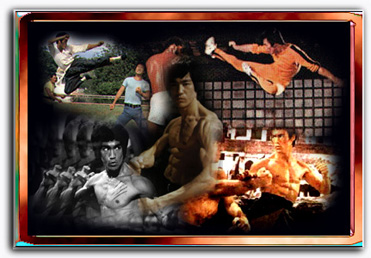
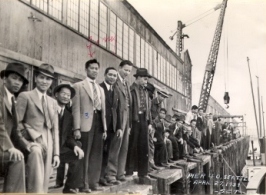


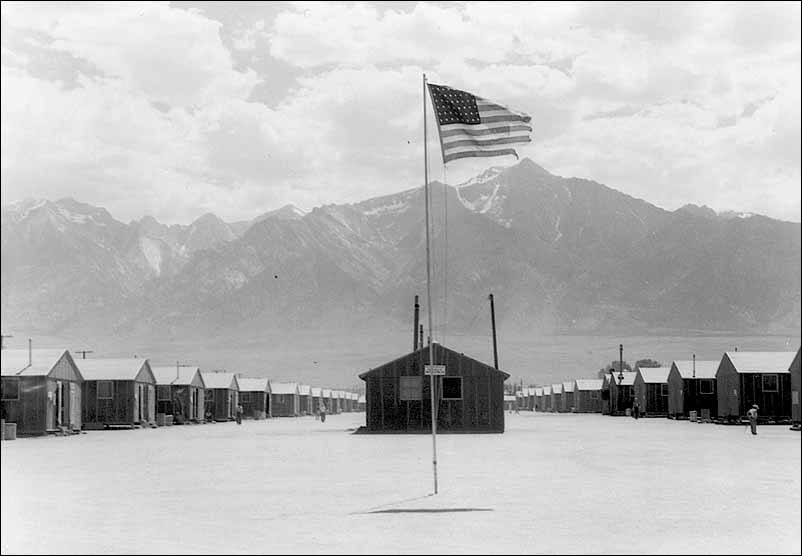
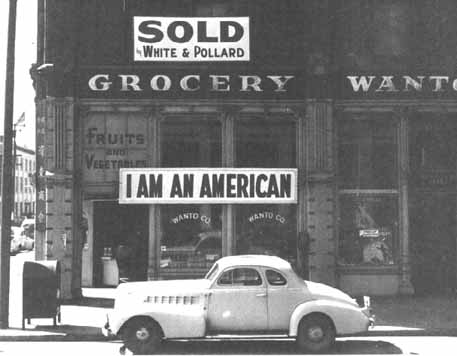
 Soldiers
stand guard as Japanese Americans await their living assignments
at Santa Anita racetrack in April 1942. About 19,000 people
lived in hastily constructed barracks or in converted horse
stalls on the grounds. (National Archives)
Soldiers
stand guard as Japanese Americans await their living assignments
at Santa Anita racetrack in April 1942. About 19,000 people
lived in hastily constructed barracks or in converted horse
stalls on the grounds. (National Archives)